|
January 3, 2026 A look back on 2025, a look ahead to 2026
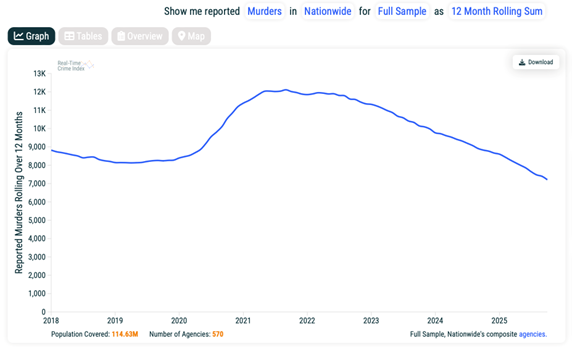
PERF members, Happy new year! 2025 was quite a year for the policing profession—and for PERF. Our nation experienced an historic drop in crime. Immigration enforcement emerged as a major challenge for police departments and sheriffs’ offices across the country. At PERF, we published reports on a range of topics, including managing officer-involved critical incidents, officer wellness, community violence interventions, and traffic safety. In this first column of the new year, I’ll reflect on these and other developments of 2025 and to look ahead to 2026, which is shaping up to be a milestone year for PERF. Dramatic drop in violent crime Last year saw a precipitous—even historic—drop in crime, particularly murder. As crime analyst Jeff Asher wrote in his year-end post on Substack, “The number of crimes reported to law enforcement agencies almost certainly fell at a historic clip in 2025 led by the largest one-year drop in murder ever recorded—the third straight year setting a new record—and sizable drops in reported violent and property crime.” The Real-Time Crime Index, run by Asher and his team at AH Datalytics, tracks and aggregates crime reports from hundreds of police agencies throughout the United States. It found that there were almost 20 percent fewer murders in the first 10 months of 2025 than in the first 10 months of 2024. Reported Murders From 570 Agencies, 2018–2025
Source: Real-Time Crime Index. In addition, violent crime was down more than 10 percent in the same period, and property crime declined by more than 12 percent. None of these data are final, and the official numbers from the FBI will not be released for some time. But all signs point to a substantial drop in crime last year. This continues a dramatic turn in what has been a tumultuous five years for violent crime in the United States, following the onset of the COVID-19 pandemic. As reported by the Real-Time Crime Index (see graph, above) murders in the agencies where it collects data increased more than 35 percent from 2019 to 2020, then increased another 6 percent in 2021. In the years since, the number of murders has dropped almost as quickly as it rose, declining 4 percent in 2022, 12 percent in 2023, 13 percent in 2024, and 20 percent in the first 10 months of 2025. The trend is unmistakable—and encouraging. There will be plenty of speculation about the potential causes of the crime spike earlier this decade and the subsequent decline, and we’ll likely never have a definitive answer. But I think a significant factor was the disruption to the criminal justice system caused by the pandemic and the 2020 protests. Fewer victims reported crimes, fewer witnesses came forward, fewer arrests were made, fewer trials occurred, and fewer criminals faced consequences. I think we saw what happens when the criminal justice system stops working, or at least when it slows down significantly. We’ve now seen several years of progress, and murders, carjacking, violent crime, and property crime are below their 2019 levels. I think this progress shows that management and leadership matter when it comes to reducing crime. Police chiefs and sheriffs know where to strategically place their limited resources. They know that a relatively small number of individuals cause a disproportionate number of offenses. And they know that identifying and apprehending repeat offenders not only make their communities safer today but also prevent crime tomorrow. I hope we can learn from what’s gone right in the past few years—especially in 2025—so that the crime drop will continue in 2026 and beyond. Immigration enforcement A second major issue facing police leaders in 2025 was immigration enforcement. Under President Trump, the federal government has made immigration enforcement a priority. The presence of federal law enforcement, particularly Immigration and Customs Enforcement (ICE), has profoundly affected local law enforcement agencies’ operations in cities across the country. Many local agencies operate under state or local laws that prohibit them from working with ICE on civil immigration enforcement. Police leaders support any enforcement that focuses on those who have committed violent crimes and other serious felonies, but they worry about the effect these federal enforcement actions are having on their relationships with their communities. We published several columns on this topic in 2025, sharing perspectives from police chiefs in large cities and sheriffs in Florida. While law enforcement leaders have different views about the appropriate way to handle immigration enforcement, all are concerned that increased federal enforcement activity will undermine the delicate relationship of trust between local agencies and the people they serve. Chiefs and sheriffs worry that some community members may stop reporting crime if they believe that doing so could lead to their own detention or deportation or the deportation of a family member. Chiefs and sheriffs have told me that people are afraid to send their children to school, go to the hospital, shop in local stores, or travel around the community. I believe police leaders support enforcement action against those who truly are the “worst of the worst,” but they are concerned about the disruption caused when enforcement action is taken against those who have been contributing members of their communities for decades. As Kewaunee County, Wisconsin, Sheriff Matthew Joski eloquently commented in early 2025, “I believe that we can continue our aggressive approach of rooting out those who prey upon our communities while at the same time creating an effective pathway for those who came to our country to pursue their dreams, better themselves, and, in the process, improve the communities they have settled in.” I am sure immigration enforcement will continue to be a major issue for PERF and the policing profession in 2026. I sincerely hope we can find approaches that improve public safety while supporting police-community cooperation and trust. PERF in 2025 Producing timely and useful research has always been a priority for PERF. Last year we published six reports in our Critical Issues in Policing series, which is supported by the Motorola Solutions Foundation:
In addition, we published reports on community violence interventions, third-party policing, autonomous vehicles, and Maryland’s Police Accountability Act, as well as 51 editions of this column. PERF programming continued to grow in 2025. More than 400 students graduated from the four sessions of our Senior Management Institute for Police (SMIP) program. This was our second year including Outward Bound as part of our instruction, offering challenging outdoor activities that help develop leadership and teamwork skills. PERF continued to hold Integrating Communications, Assessment, and Tactics (ICAT) train-the-trainer sessions at our training facility in Decatur, Illinois, instructing officers from across the country, as well as members of the Ukrainian and Colombian national police agencies, in the latest approaches to minimizing the use of force. This facility was built with the generous support of the Howard G. Buffett Foundation, and PERF offers free ICAT training to any agencies that get their trainers to Decatur. An evaluation of ICAT in the Indianapolis Metropolitan Police Department, published in 2025, found the training was associated with statistically significant reductions in officer uses of force and injuries to subjects—findings that mirrored the results of an earlier evaluation of ICAT in the Louisville Metro Police Department. In May, we held our Annual Meeting in Nashville, where we discussed immigration enforcement, PERF’s The First Six Months report, and the Metropolitan Nashville Police Department’s response to the 2023 Covenant School shooting. And we welcomed hundreds of attendees to our Town Hall Meeting at the October IACP Conference in Denver for conversations about National Guard deployments, real-time crime centers, and the Force Science Institute’s research.
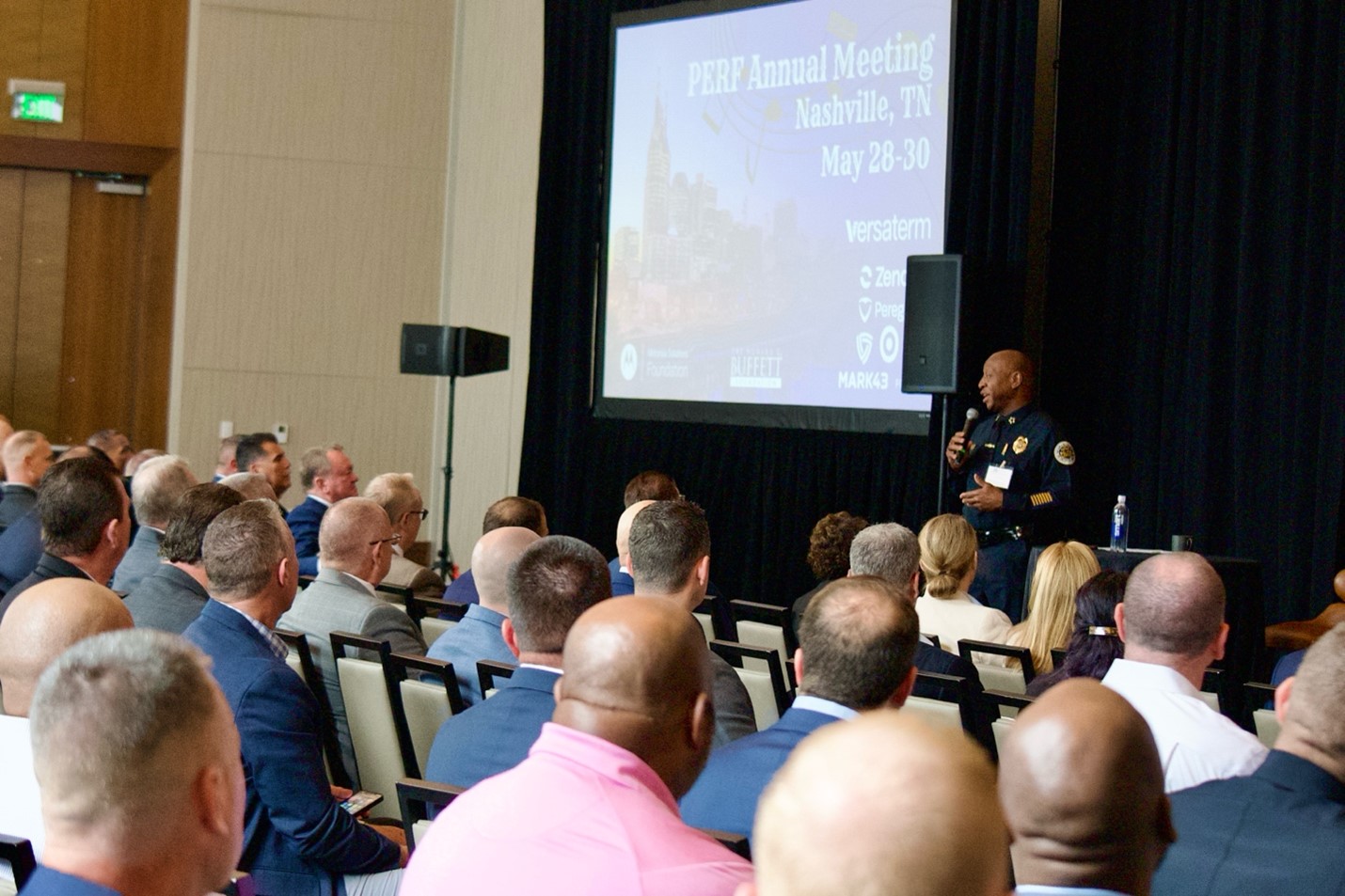
PERF President and Metropolitan Nashville Police Chief John Drake welcomes attendees to the 2025 PERF Annual Meeting. PERF celebrates three major milestones in 2026 Looking ahead to 2026, PERF will be celebrating several significant milestones. This year will mark the 50th anniversary of PERF’s founding. In 1976, 10 police chiefs came together to form an organization that would study policing and challenge the profession’s conventional thinking. They wanted a body that would speak truth to power when the facts on the ground necessitated it, even if it wasn’t always politically popular. Today, PERF members want the organization to remain an apolitical venue for sharing their views, and I see that as our mission. We will continue to do our best to make ourselves heard! This summer PERF will hold the 100th session of our SMIP program. In the past 44 years, more than 7,000 police leaders have graduated from the program, and we’ll be hosting another four sessions this summer. And 2026 will be the 10th anniversary of our ICAT training program. In the past decade, more than 150 agencies across 36 states, the District of Columbia, and Canada have implemented ICAT, including the entire state of New Jersey. We’re constantly thinking about how we can continue to grow ICAT and better incorporate it into the day-to-day work of police officers and sheriffs’ deputies. I welcome any suggestions you might have. I’ll have more to say about all three of these milestones in the coming months. I hope you’ll be able to join us at one of our upcoming events. On February 9–10, PERF will host our Fourth Annual National ICAT Conference in Clearwater Beach, Florida. And on April 15–17, we will hold our Annual Meeting in Los Angeles. Look for registration information for that meeting next week. In the first half of this year, we’ll also be working on projects about mitigating the threat posed by malicious drones, training detective supervisors, and improving in-service training. In short, we have a lot planned for 2026. I look forward to once again having you along for the ride! Best, Chuck |