|
April 25, 2026 Real-time crime centers, violent crime, and immigration enforcement
PERF members, Last week I shared a couple of the discussions from our Annual Meeting in Los Angeles. Here are some of our members’ comments on the emergence of real-time crime centers, the precipitous drop in violent crime, and the continuing challenge of increased federal immigration enforcement. REAL-TIME CRIME CENTERS
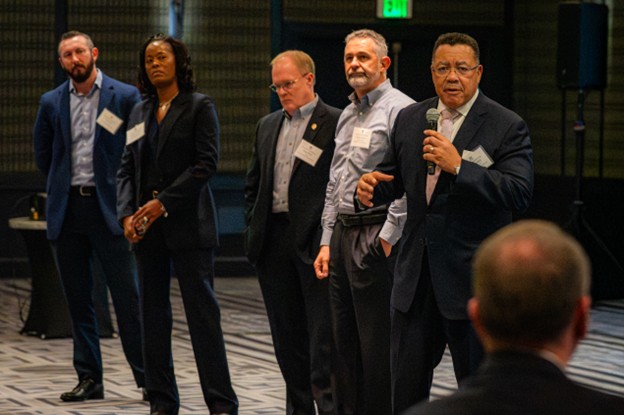
L to R: Wichita (KS) Deputy Chief Paul Duff, Dallas Assistant Chief Catrina Shead, Bakersfield (CA) Chief Greg Terry, Tempe (AZ) Assistant Chief James Sweig, and Philadelphia Police Commissioner Kevin Bethel discuss real-time crime centers at the 2026 PERF Annual Meeting. Tempe (AZ) Assistant Chief James Sweig: “Definitely this is a game changer. It’s a problem solver. We had a problem responding to crimes in progress, and we didn’t know how to solve it. “I also think it allows us to prevent sending officers to calls [unnecessarily], because if we get a call of a vehicle collision or stranded motorist, we can see cameras in the area and determine if somebody really is there or that circumstance exists. If we find that’s not the case, it keeps them from having to go. “Our detectives are using this product as well. We have solved a homicide within 10 minutes when there was a meet-up situation. We got plates on that vehicle and we had that person in custody within five hours. That has been very effective.” Bakersfield (CA) Chief Greg Terry: “We’re about six weeks up and running in our real-time information center. We have 500 officers and cover about 160 square miles. We have just over 400 cameras that are now integrated into the center. It’s completely staffed with civilian staff, both crime analysts and dispatchers. We’ll have officers move in and out. “Over the last six weeks, it’s been an amazing tool. So far we’ve arrested suspects for homicide, domestic violence, and fatal hit-and-runs. We’re already benefiting from the efficiencies of being able to watch where people are moving around the city in real time. We’re no longer just flooding an area looking for a red truck. We’re going to the red truck.” Dallas Assistant Chief Catrina Shead: “In Dallas, we’re really heavy on technology. We didn’t have a real-time crime center until maybe eight years ago. Prior to that, we had a fusion center, but it was kind of behind. Our center includes sworn and nonsworn. We have officers from different agencies, such as local transit officers. It’s really important for us to pull in every piece of technology.”
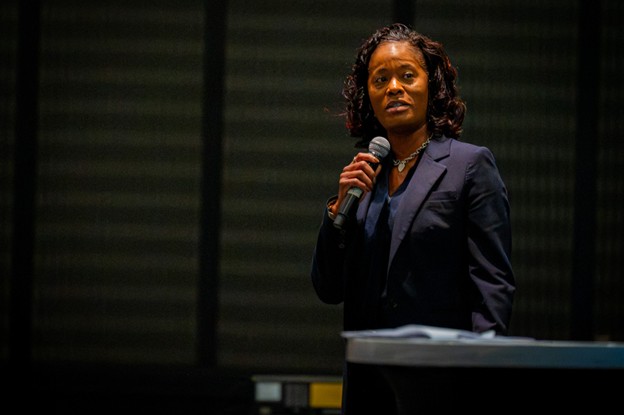
Assistant Chief Shead. Wichita (KS) Deputy Chief Paul Duff: “I started looking at a real-time crime center almost four years ago. I looked at a lot of grants, and eventually got about $1.65 million in COPS [Office] grants. And we were a PSP (DOJ National Public Safety Partnership) site, and we ended up getting $500,000 through PSP as well. “I did a lot of traveling around and a lot of talking and listening to chiefs, and many said, ‘You better talk to the community. Get ahead of the community.’ So we did town halls and engaged the public in different neighborhoods to say, ‘We’re going to have gunshot detection, drones, and license plate readers.’ We got a lot of input on all these different areas. “We opened it last August. We got it built, then we had a staffing issue. The union didn’t want to pull officers from the streets for the real-time information center. So we’ve used pregnant officers, injured officers, and civilian staff. We have two full-time staff now and put in for four more civilians in the budget.” Montgomery County (MD) Commander Amy Daum: “We have historically been understaffed—not just now, but pretty much forever. So we’re leveraging technology to try to address the staffing issues that we’re having. We’re also seeing, as we always have, that a lot of our criminals don’t come from Montgomery County. They come in from other areas. So we use technology to figure out where they are coming from, so we can determine how we get ahead of it and stop them. “We recently put more LPRs (license plate readers) in major corridors from D.C. into Montgomery County. And we started a drone as a first responder program.”
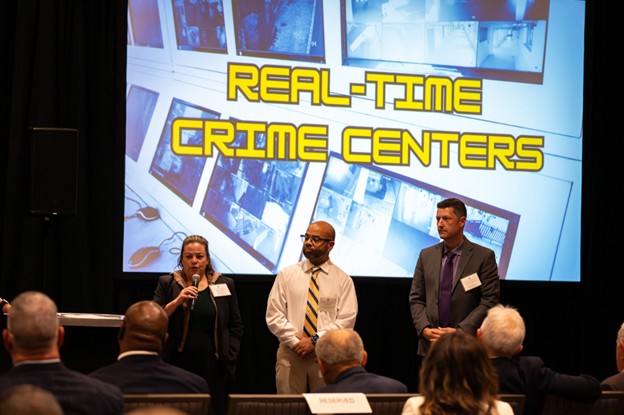
Montgomery County Commanders Amy Daum, David Smith, and Jason Cokinos describe their agency’s real-time crime center with the Annual Meeting crowd. DECREASES IN VIOLENT CRIME Metropolitan Nashville Chief John Drake: “Violent crime is down throughout the nation, and the question is what is really driving it down. Is it our practices? Is it the combination of a lot of different things? Some people will say that it’s immigration enforcement, but I don’t think so. “We’re having historic lows. Our residential burglaries are at a 60-year low. Aggravated assaults, 50-year low. Homicides, 12-year low. We have all these lows, and we’re trying to figure out what’s driving that. Our clearance rate for homicides went from 37 percent to 82 percent, so there are a lot of things we’re doing, but is that what is really driving crime down? “When the mayor says, ‘Hey, you’re doing really well and crime is down,’ I say, ‘Well, I don’t want to take credit for that.’ That’s a combination of everything. Because one day it’s going to go up, and then the questions are going to be, ‘What are you doing differently? What are you not doing? Why are you not effective?’ And so I just try to be careful with that.” Milwaukee Chief Jeffrey Norman: “In Milwaukee, we’re down as well. But the highest homicide issues for us is poor conflict resolution and the accessibility of firearms. Kids still have access to firearms, because we do not have firearm laws about keeping your guns locked up.”
Chief Norman. Knoxville (TN) Chief Paul Noel: “I’m lucky enough to be in a city with no homicides so far this year. I think we’re doing a really great job of overlaying offender-based and place-based programs with data. We’re training our whole department, shifting the culture to focus on the most violent individuals, and getting out there to walk and interact with people in those place-based areas. I’ve never seen a city government and police department more aligned with trying to get resources in our most violent communities.”
Chief Noel. Philadelphia Commissioner Kevin Bethel: “I came back in 2024 after being away for seven years. Now I have officers with phones getting real-time information. I have in-car cameras, so as soon as we get a hit, we know where that car has been. I have tools to break into phones. I have license plate readers on poles. I have rapid DNA. I can bring all that together and add in prevention. For the first time in my career, we’re ahead with our technology.” St. Louis Metropolitan Chief Robert Tracy: “We were at 263 murders in 2020 and last year we were at 140, which was the lowest in about 25 years and the third-lowest in 35 years. But it’s still too high for a city of 300,000 people. “I was in the NYPD for 10 years before Bill Bratton came in and transformed how we did things and how we fought crime. By taking those same principles and operationalizing the real-time crime centers and all the other technology we have today, we’re seeing results.” FEDERAL IMMIGRATION ENFORCEMENT Pinellas County (FL) Sheriff Robert Gualtieri: “Our legislature and our governor passed laws in Florida that say we have to enforce immigration law and cooperate with ICE. I said to my community, ‘How many people think that if you’re in this country illegally and committing rapes, robberies, murders, and burglaries and wreaking havoc in the community, you should stay?’ And people would say, ‘No, we don’t want them there. We don’t want to be victims of this.’ So we focused on the people who were committing crime. “At the same time, I believe the people who are here for 10 or 15 years, who are moms and dads, who work, who you sit next to in church on Sunday, they’re as much victims as anything else because of an absolutely failed immigration system. “We didn’t go after those moms and dads and the people who’ve been here and instead focused on the criminal illegal immigrants. We kept ICE and Enforcement and Removal Operations so busy with the people we turned over from the jail that they didn’t have the time and resources to go out and do some of the things they were doing elsewhere.”
Sheriff Gualtieri. Minneapolis Chief Brian O’Hara: “The surge in Minneapolis and greater Minnesota lasted about 12 weeks. For at least half of that, I would say the city of Minneapolis was on the precipice of destruction almost constantly. This doesn’t reflect all the Border Patrol agents, ICE agents, DHS, and other feds around the country, but I can tell you that in Minneapolis, there were enough people from law enforcement acting a fool for weeks that you would think this is what they were being told to do. It was unbelievable how indifferent and reckless their behavior was. “It started at the beginning of December. I’d get questions from the media and tell people that we were heading toward a tragedy. Either a law enforcement officer or someone from the community was going to get killed, because that’s how crazy everything was. There were three shootings in the city. “The city is very engaged, and it’s pretty far to the left. The cops were getting thrust into that environment. The department is still about 40 percent below authorized staffing. Crime is still higher than it was before 2020. We had about 600 cops while the surge was going on, and at the high point I think there were about 4,000 federal agents. The entire state has less than 10,000 licensed police officers, between the sheriffs’ offices, state troopers, and everybody. Just think about the overwhelming nature of that. There was so much going on everywhere and it was totally overwhelming for the system. “We were trying to hold crime scenes because they shot somebody. There were thousands of people coming out to demonstrate. And the feds were still riding around on the periphery doing jump-outs. It was just unbelievably reckless with no end in sight. “Because the issue is so political, we couldn’t do right by anybody. For some folks on the right, including some other folks from law enforcement, we were wrong for not intervening to help ICE do their job. But a lot of folks on the left, which is the majority of who lives there, were saying we were wrong for not trying to arrest federal law enforcement while they’re enforcing federal law. Anytime there was an arrest, it was a ‘kidnapping.’ That was the language being used. “There’s no magic that holds the system together. It takes people in positions doing their jobs according to the rule of law, and it’s scary how close we came to things falling apart. More than half the federal prosecutors in Minneapolis quit during this thing. At least one FBI supervisor resigned, and other people went on leave. I had an attorney because people high up told me that there were discussions about arresting me and taking me into custody for inciting an insurrection. That’s how ridiculous this thing was.” Los Angeles Chief Jim McDonnell: “In early June, the sheriff and I heard that there was going to be some kind of enforcement action. We didn’t know what it was going to be. We went and met with the U.S. attorney and Tom Homan. We told them flat-out that if they’re thinking of doing what we thought they might do, this city may burn. But they had marching orders and were going to do what they had to do. “They came into town and hit both the county and city areas. It started off in the city area and then it was one thing after another. There was no de-confliction and no communication to ensure there were no blue-on-blue incidents. I was very worried about that.
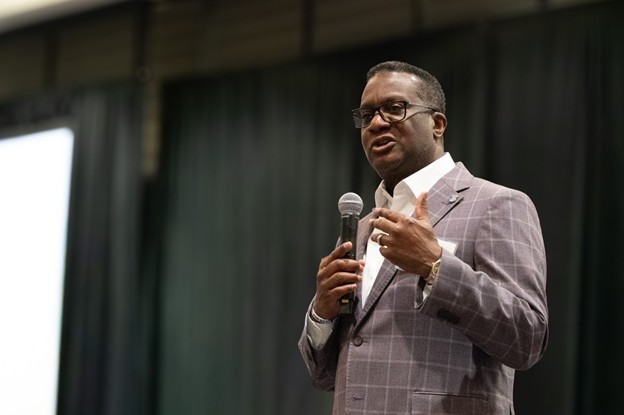
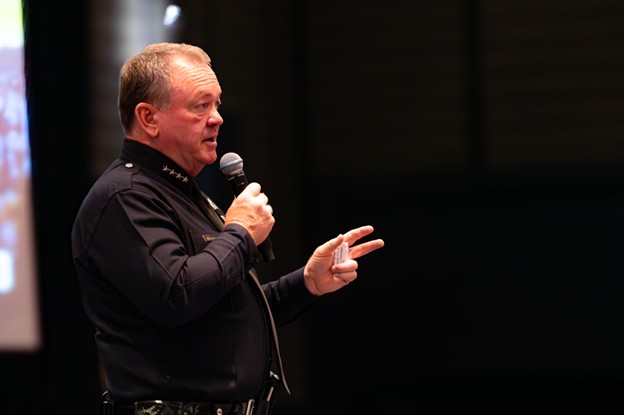
Chief McDonnell discusses immigration enforcement at the PERF Annual Meeting in L.A. “I’m proud of the great relationships we have at the federal, state, and local level, and we still have that with all our federal partners. But the ICE agents assigned to L.A. are not the ICE task force we saw come to L.A. We saw a variety of different entities deployed for this purpose, and we had ICE task force agents whose regular duties were on the Canada-Vermont border. They had never been to Los Angeles. They didn’t really have a clear mission. The tactics that were used were very concerning. They’d jump out of the car and jam a car full of people that they suspected of immigration violations. The potential for an armed encounter in L.A. is significant. If they had dealt with a carload of gang members, that could have gone very wrong very quickly. “We had worked for a half-century trying to build trust with our immigrant communities and had come a long way. A lot of that was eroded pretty much overnight. We continue to be guided by the policy that the LAPD has had for 47 years, which is not to enforce civil immigration law. We have a very large immigrant population here, and if we did that it would have a chilling effect on people’s willingness to come forward to report crime, which would be detrimental to everybody. We’ve had that policy since 1979, and we still maintain that today.” Thanks to everyone who spoke up at our Annual Meeting! Best, Chuck
|