|
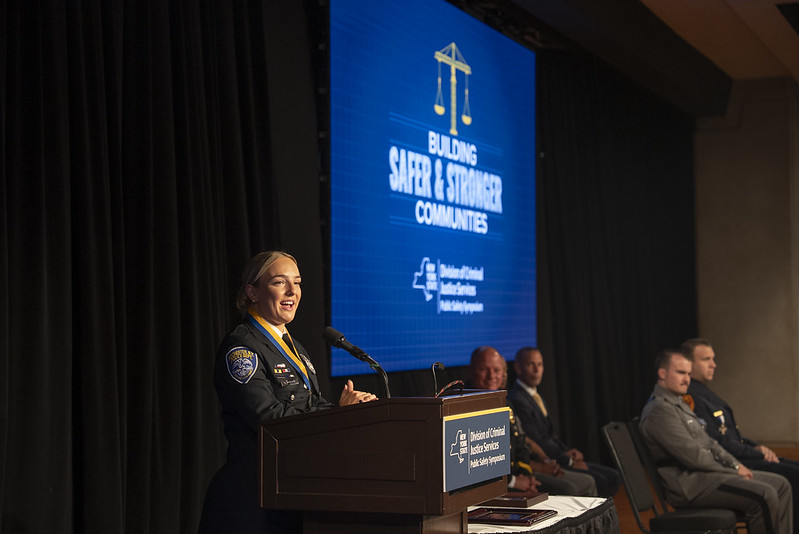
October 17, 2026 The Disasters that Never Were — Policing Adapts and Is Better For It PERF members Last month, the New York State Governor named Rochester Police Department Officer Nicole Amatore the 2026 Police Officer of the Year. On December 19, 2025, Rochester police responded to a 911 call reporting that a man, possibly armed with a gun, was attempting to break into his ex-girlfriend's house. Officers encountered him outside, where over the next several minutes he shot and wounded three police officers and a civilian. A fourth officer, Nicole Amatore, took cover behind a tree as the suspect fired in her direction, striking the tree. Despite being under attack, she returned fire and killed the shooter.
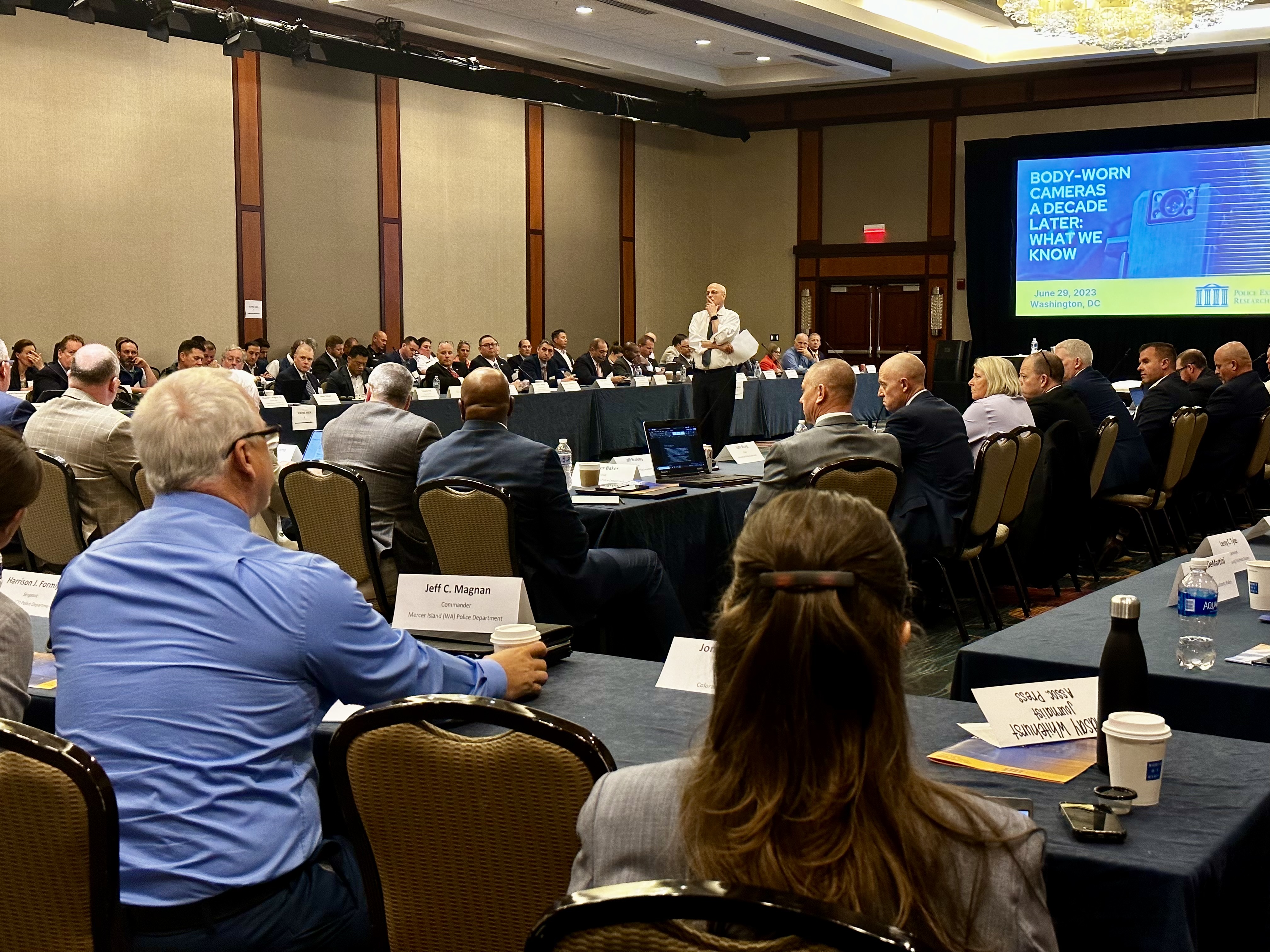
Officer Amatore accepts the 2026 Police Officer of the Year honors. Source: New York State Division of Criminal Justice Services. There is no need to speculate about the courage Officer Amatore displayed that night—we can see it with our own eyes on the body-worn camera (BWC) footage of the incident. That video provided something that, until relatively recently, was often unavailable in critical incidents: an objective visual record of what took place. In an earlier era, the public was largely left to weigh competing accounts from police officers, witnesses, and others at the scene. Today, in many cases, the footage speaks for itself. Yet when BWCs first emerged, the law enforcement community met them with considerable resistance. When PERF wrote about cameras in 2014, many warned that the technology would discourage proactive policing, hindering officers and exposing them to unfair scrutiny. Today, the landscape has shifted. At a 2023 PERF meeting, when I asked police executives from across the country, "If tomorrow you could eliminate body-worn cameras, would you?"—not a single hand went up.
PERF’s 2023 meeting on body-worn cameras. In the past 10 years, local and state agencies have come to rely heavily on BWCs as independent witnesses to their actions. A byproduct of using these cameras has been fewer complaints against officers and faster adjudication when complaints do occur—in the past, when matters rested exclusively on one person’s word against another, the adjudication process could be lengthy, and it can now often be resolved quickly. What many officers and unions initially feared would be a tool for second-guessing police decisions has in many critical incidents become one of the strongest defenses of officers acting lawfully under difficult circumstances. Policing has seen this pattern before: seemingly entrenched resistance to a change, followed—after a time—by near-universal acceptance. In fact, some reforms, now so widely accepted that officers rarely give them a second thought, were once condemned as dangerous, impractical, or even career-ending. The pattern is strikingly consistent: Predictions of disaster give way to adaptation, and adaptation eventually becomes routine. Consider Miranda warnings. In Miranda v. Arizona, decided in 1966, the U.S. Supreme Court held that suspects in police custody must be informed of their constitutional rights before interrogation, including the right to remain silent and the right to counsel; statements obtained in violation of Miranda generally could not be introduced at trial. Many officers and agencies were already advising subjects of their rights before the Court required it. But many others were not, and they reacted to the Court’s decision with disbelief, warning that it would make it nearly impossible to solve crimes and secure convictions. Critics predicted that suspects would simply stop talking and that law enforcement would lose one of its most important investigative tools. Fast forward to today—law enforcement agencies continue to solve and clear significant numbers of cases while respecting the constitutional protections guaranteed by the Bill of Rights. What was once seen as an impediment has become a routine and widely accepted part of professional policing. Or take officer-involved shootings. In 1972, the NYPD recorded nearly 1,000 officer-involved shootings, a staggering figure when viewed through a modern lens. What brought that number down? A significant factor was a new policy (implemented late that year) prohibiting officers from shooting at moving vehicles unless a vehicle occupant was using deadly force independent of the vehicle itself, such as by firing a weapon. This policy shift caused an almost immediate and dramatic reduction in officer-involved shootings. Yet before the policy was adopted, critics warned that it would endanger officers' lives and leave them unable to protect themselves in dangerous encounters. Those dire predictions never materialized. But the reduction in officer-involved shootings did. During the first quarter following implementation of that policy, officer shootings dropped by a stunning 40 percent, and no police officers died. Fifty years later, this policy remains the gold standard adopted by most major cities. Another example is recording custodial interrogations. I can remember bringing together homicide supervisors in the 2000s to discuss this issue. There was considerable resistance. Even as advocates and state legislatures pushed for videotaped interrogations, the prevailing consensus among law enforcement was that witnesses would be reluctant to talk, and others believed that jurors viewing lawful but aggressive interrogation tactics would find them coercive. In 2005, Illinois became the first state to require them in homicide cases, and most states have followed suit, through statutes or court decisions. Since then, recorded interrogations have become standard practice. And in fact, most investigators prefer them, as they create an objective record of what took place, help protect officers against false allegations, and allow prosecutors to present a defendant's own words directly to a jury. A reform that was once viewed with skepticism is now widely regarded as a valuable investigative safeguard. Policing can benefit from advances in other fields as well, of course. I remember when DNA exonerations began exposing how fallible and suggestible the human mind can be in identifying suspects. But investigators were initially skeptical of replacing traditional identification procedures with double-blind procedures administered by someone who did not know the suspect's identity, despite research showing that conscious and unconscious cues could influence witness selections. Academics and others warned that conventional practices risked steering witnesses toward a particular choice rather than testing their actual memory. Yet as wrongful-conviction cases mounted, agencies adapted. Today, blind administration and other eyewitness-identification safeguards are widely accepted and, in many jurisdictions, required. I’ll give one final example. In 1999, the Philadelphia Inquirer published an investigative series highly critical of the way the Philadelphia Police Department was handling sexual assaults. In response, then-Commissioner John Timoney did something highly controversial: He brought in the Women's Law Project to work alongside Philadelphia detectives, review sexual assault files, and identify the best path forward. You can imagine how detectives felt about this. Their chief was inviting advocates into what many regarded as exclusively police work.
John Timoney attends a 2015 PERF meeting on use of force training. The result? Detectives and advocates worked together and found common ground. John Timoney understood that simply changing policies would not regain public trust. He was right, and many detectives eventually came to the same conclusion. That decision, which was deeply unpopular with much of the rank and file at the time, led to what became known as the Philadelphia Model—a landmark reform that helped redefine best practices in sexual assault investigations. What strikes me about all these examples is that they are a testament to policing's ability not only to adapt to challenges but also to emerge stronger because of them. Think about that for a moment. Few professions have faced so many evolving challenges, and time and again policing has risen to meet them—learning, improving, and preparing for whatever comes next. I can’t predict what the next perceived threat to effective policing might be. But history suggests a safe bet: Today's controversial reform may well become tomorrow's accepted practice. Best, Chuck |