|
July 11, 2026 What are the best practices for preventing, responding to, and investigating intimate partner violence?
PERF members, As law enforcement agencies work to reduce violence in their communities, intimate partner violence (IPV) is a persistent challenge. Last Friday night, the Bexar County, Texas, Sheriff’s Office responded to two deaths that they suspect were an IPV-related murder-suicide. Five of the 10 homicides the agency has responded to so far this year are believed to be IPV related. Bexar County isn’t unusual. The Bureau of Justice Statistics reports that in 2023, 13 percent of all homicide victims and 36 percent of female victims were killed by an intimate partner. A Centers for Disease Control and Prevention study of adult female homicide victims in 18 states from 2003 to 2014 found that 55 percent were killed in IPV-related incidents. (I’m using “intimate partner violence” rather than “domestic violence” because the latter category includes violence against family members other than intimate partners, but the two terms are often used interchangeably.) And these situations are dangerous for responding law enforcement as well. Ten years ago, Prince William County, Virginia, Officer Ashley Guindon was shot and killed while responding to an IPV call. She was only 28 years old, and it was her first day on patrol. More recently, three Pennsylvania law enforcement officers were killed and two were injured when responding to an IPV call in September 2025. Police have implemented a variety of strategies to reduce and better respond to IPV incidents over the past five decades. Historically, when police were called about a couple fighting, they may have responded by separating the two and asking one of them to leave the house. Officers thought the couple would resolve their differences and that would be the end of it. But these often are patterns, not one-off incidents, and people can be seriously injured or killed. To test various responses to IPV incidents, Lawrence Sherman and Richard Berk published a landmark study in 1984 on the Minneapolis Police Department’s response to these calls. Officers responding to misdemeanor domestic assault cases were randomly assigned to arrest the suspect, remove the suspect from the scene for eight hours, or attempt to mediate the conflict at the scene. This was a controversial experiment, particularly because then-Minneapolis Police Chief Tony Bouza allowed researchers to randomize officers’ response to IPV incidents. The researchers found that “arrest was the most effective. . . . The other police methods—attempting to counsel both parties or sending assailants away from home for several hours—were found to be considerably less effective in deterring future violence in the cases examined.” The following year, a federal jury awarded a Connecticut woman $2.3 million because her local police department did not take her complaints about the threat she faced from her husband as seriously as they took other criminal complaints. After she repeatedly reported his threats to the police, he violently attacked her, leaving her partially paralyzed. The Minneapolis study and Connecticut case led some agencies and states to establish mandatory or preferred arrest policies and laws. Congress passed the Violence Against Women Act in 1994. Among other stipulations, the legislation required that states honor each other’s protection orders; funded law enforcement training, victim support services, legal aid, and prevention programs; and established the National Domestic Violence Hotline and the Department of Justice (DOJ) Office on Violence Against Women (OVW). In the 1990s and 2000s, many agencies established IPV fatality review teams that analyze homicides to identify systemic gaps and improve community and agency responses, and lethality assessment programs, which establish a structure for evaluating the danger posed by a potential offender. At times, new research findings have called longtime practices into question. Sherman and Berk’s Minneapolis study was replicated in Milwaukee by Sherman and others in the late 1980s. The researchers found that “while arrest deters repeat domestic violence in the short run, arrests with brief custody increase the frequency of domestic violence in the long run among offenders in general.” In a 2014 follow-up study of the victims in that Milwaukee study, Sherman and Heather Harris found that, more than two decades later, “victims were 64 percent more likely to have died of all causes if their partners were arrested and jailed than if warned and allowed to remain at home.” These startling findings added nuance to the Minneapolis study’s conclusions about mandatory arrest policies. If arrests were causing worse mortality outcomes, should states undo previously passed mandatory arrest legislation? More recently, states have passed laws to increase penalties for IPV and mandate lethality assessments. This past December, the United Kingdom published Freedom from Violence and Abuse: A Cross-Government Strategy to Build a Safer Society for Women and Girls, a national strategy that addresses three areas: prevention and early intervention, relentless pursuit of perpetrators, and support for victims. London Metropolitan Police Commissioner Sir Mark Rowley spoke to me about this strategy earlier this year. “We’ve been taking every offender we have down as a suspect for the last year or two, aggregating all the things we know about them, and coming up with relative scores to pick the top 100,” Sir Mark said. “With that top 100, we’ve created intelligence profiles, and we’ve looked at how we can get them off the streets and in prison.”
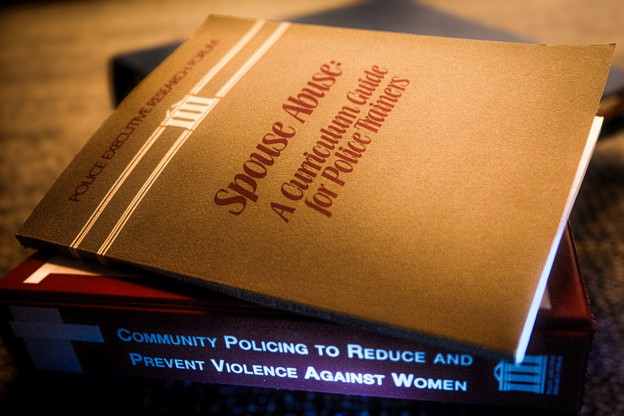
PERF publications Spouse Abuse: A Curriculum Guide for Police Trainers and the training guide Community Policing to Reduce and Prevent Violence Against Women. PERF has done some work on IPV over this timeframe. In 1981, we published Spouse Abuse: A Curriculum Guide for Police Trainers by Nancy Loving. In the 1990s, we created a training curriculum on using community policing to reduce and prevent violence against women. And we published Identifying and Preventing Gender Bias in Law Enforcement Response to Sexual Assault and Domestic Violence in 2016 with support from the DOJ Office of Community Oriented Policing Services. But we haven’t done nearly enough, and I hope to start remedying that this year. Thanks to support from OVW, we have just released the Roadmap to Best Practices for Gender-Based Violence Response and Investigations, which provides practical recommendations for implementing the DOJ’s 2022 guidance on Improving Law Enforcement Response to Sexual Assault and Domestic Violence by Identifying and Preventing Gender Bias. And we will soon be releasing accompanying tipsheets on topics such as improving IPV police reports, identifying the predominant aggressor in IPV incidents, and ensuring accountability in officer-involved IPV cases.
The starting page of the new roadmap on PERF’s website. And this September, we’ll host a national meeting on the policies and practices law enforcement agencies have implemented to reduce IPV and improve responses to these cases. We will then produce a report on our findings. Topics I expect this meeting to address include the following:
If you have ideas for that meeting, such as innovative strategies your agency has put in place, please let me know. I hope we can help agencies improve their prevention of and response to IPV. Best, Chuck |