|
January 17, 2026 London Metropolitan Police Commissioner Sir Mark Rowley on crime reduction strategies, addressing violence against women, the use of facial recognition, and deploying drones
PERF members, As the commissioner of the London Metropolitan Police, Sir Mark Rowley is responsible for managing the 46,000 officers and professional staff who protect the city’s 9 million residents. In early January, I spoke with Sir Mark about London’s historically low homicide rate, his agency’s policing strategies, their use of facial recognition and drones, and why he wrote a terrorism thriller during his initial retirement.
Chuck Wexler: How many homicides did London have in 2025?
Sir Mark Rowley: Ninety-seven. This is the second time in our history we’ve dipped under 100, and it’s the lowest per capita rate that London has ever had.
So it’s pretty exceptional. We’ll talk about the how in a bit, but the combination of how good we are at solving murder, the way we’ve borne down on organized crime and drugs-related violence, and the day-to-day innovation and pace of what we do with bearing down on criminals, all of that adds together.
Wexler: What is the Met’s clearance rate for homicides?
Sir Mark: Most years, 95 percent, and last year was a typical year. We have a British murder model that was built out on the back of a couple difficult cases in the 1980s. We have a team-based approach. We have quite an old computer system, but it’s very systematic and thorough. And we put great detectives on these cases. If you kill somebody in London, you’re almost certainly going to get caught.
A murder case will be led by a detective inspector or a detective chief inspector. They will have a team of maybe 20 or more people working for them. They will pick up maybe a murder every couple of months, so they have quite a lot of time to work on these cases.
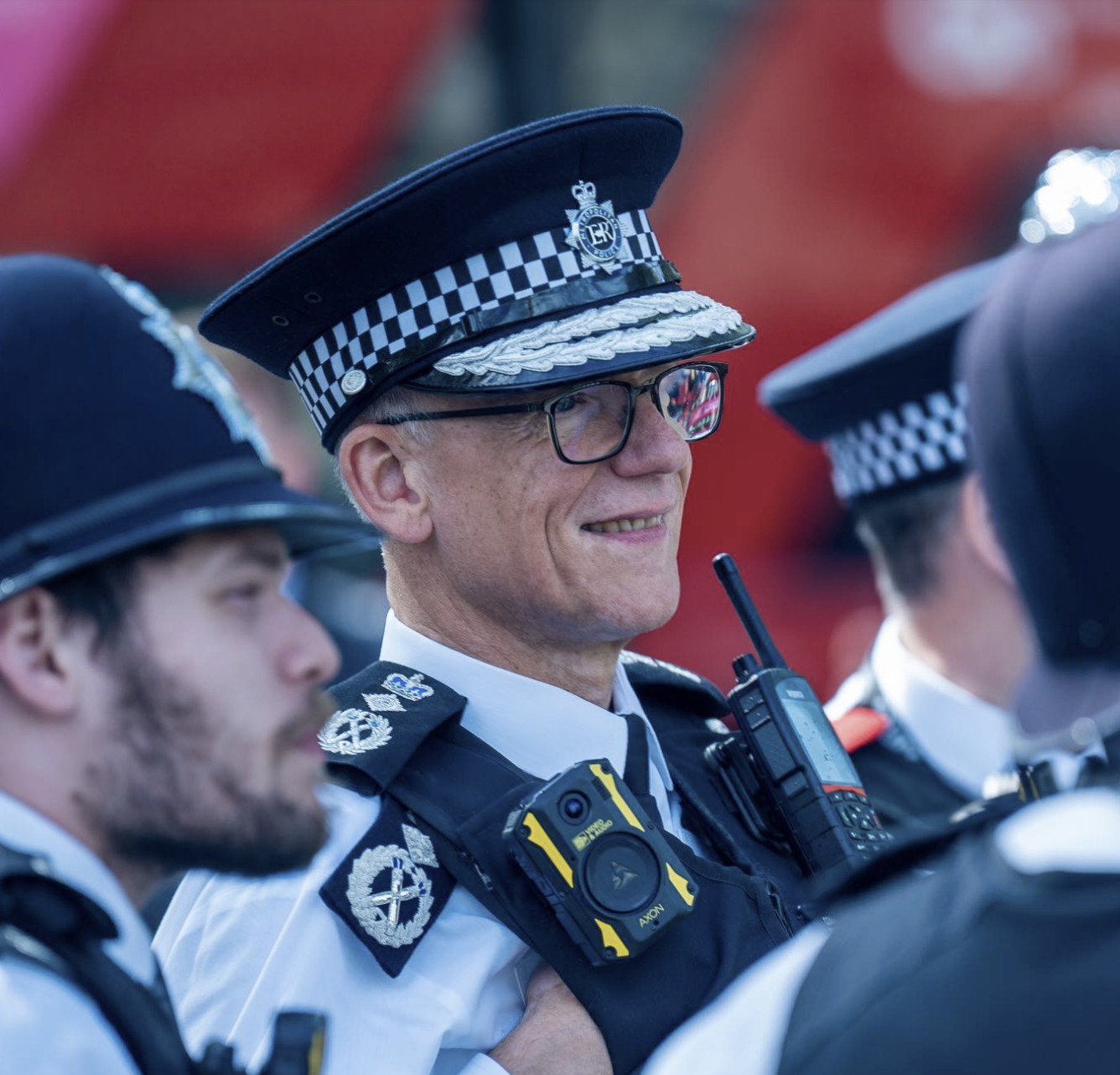
Commissioner Sir Mark Rowley on patrol with officers in Westminster as they welcome visitors from around the world to London to enjoy the May 2023 coronation. Source: Instagram Wexler: Tell me about how you’re using facial recognition. Sir Mark: There are two key ways. We use two acronyms—RFR and LFR, for reactive facial recognition and live facial recognition. Live facial recognition is us putting the technology on the street, which we’ve primarily been doing so far with a van that has cameras all the way around the roof and basically can see everyone walking past that point. We deploy those vans in high footfall, high crime areas with a team of officers. We’ve been very careful because of the public trust issues. There’s a British standards body called the National Physical Laboratory. We had them evaluate the software we were going to use and test it, so they’ve given us some parameters within which to use it where they will guarantee high accuracy and fairness. By fairness, I mean it’s equally accurate—male, female, Black, White. So we’ve worked hard on proportionality and accuracy. Secondly, we’ve been careful not to put every photo we’ve ever collected in there. We’re putting wanted offenders in there, so people who we know have committed an offense and we want to arrest them or they’ve been given a warrant by the court. We’re also putting in people who are on court orders, such as registered sex offenders. So we have a threshold for what we put in there. We’re routinely finding that in a two-hour operation in a high crime, high footfall area, we might make 15 arrests. They’ll be people wanted for assaults, rape, skipping bail. There’ll be two or three of them who are registered sex offenders who breached their conditions. Maybe they’ve got electronic devices that they hadn’t registered with the police, that sort of thing. Last year, we arrested 1,135 people as a result of these facial recognition operations. It’s having a really powerful effect, and because of all the communications and marketing we’ve done on it, we’ve got 85 percent public support in London surveys.
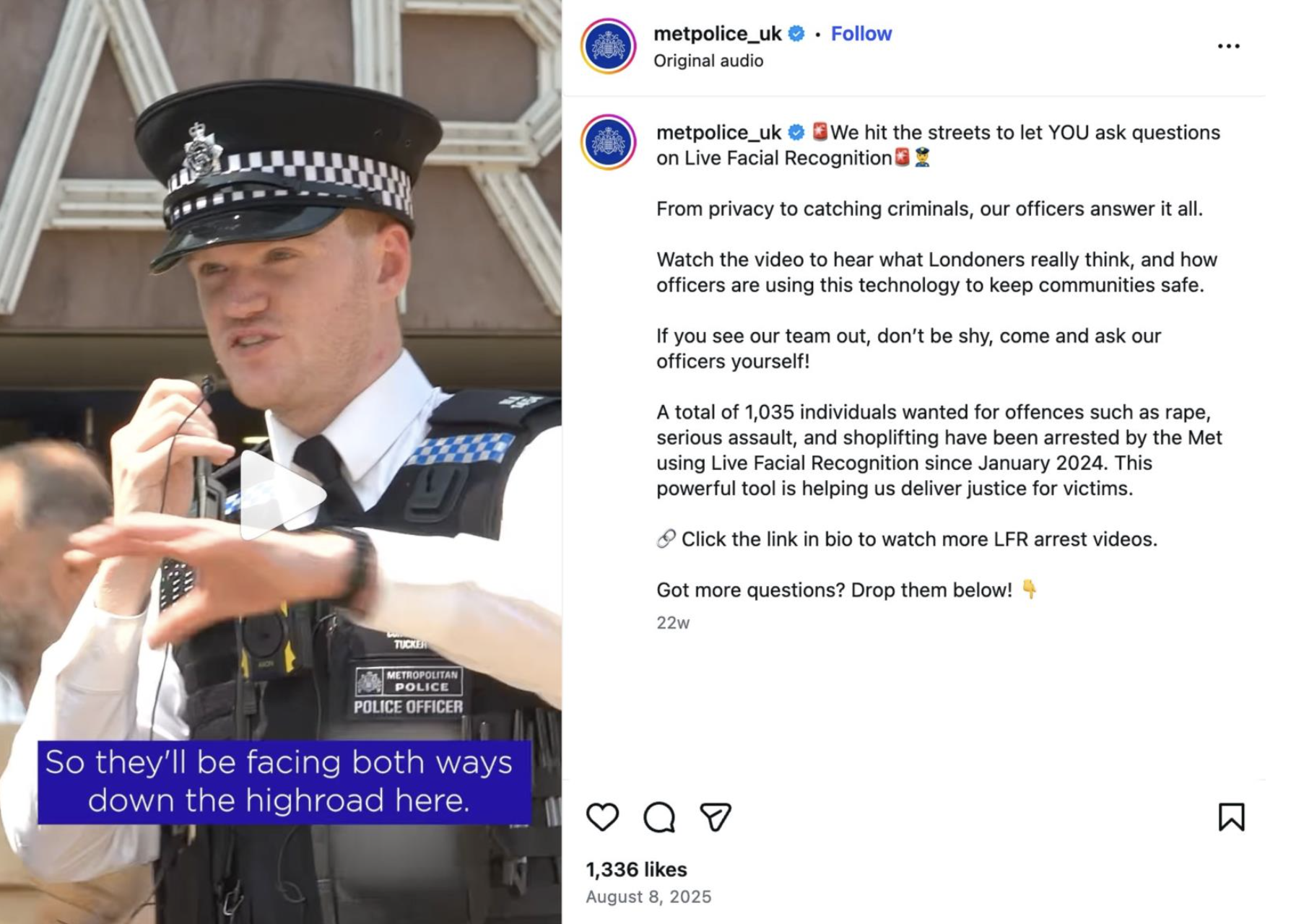
A London Metropolitan Police social media post sharing details on the use of LFR technology. Source: Instagram Wexler: Why do you think the public is so supportive? Sir Mark: Britain has had decades of quite high investment in CCTV, and people are used to that as an idea. So it’s not the first technology they’ve had on the streets. We’ve been proactive in our media and communications about what we are and are not using it for. We keep ramming home the point that we’ve tested it and it’s not disproportionate. So I think we’ve worked hard to earn the legitimacy through the way we’ve deployed it and our communication. When we do our operations, we put media teams around them. Almost every media outlet in the UK has come out at least once with these operations and done features on them. So we’ve worked hard to show that this isn’t Big Brother. This is a really helpful way for cops to arrest people. I make the point that this is less intrusive than normal hot spot policing. We talk about stop and search, and I think in America you talk about stop and frisk. If you put cops on a street doing stop-and-frisk operations, however good the intelligence and however good their police instinct is, some of the people they stop will actually turn out not to be criminals, because it’s not a perfect tactic. It has a good suppressive effect. Facial recognition is as close to perfect as you can get. In a year where we arrested 1,135 people and 3 million people walked past the cameras, we had eight false identifications, of which only four were stopped. The other four were so obviously false that they weren’t even stopped. The four who were stopped, it was a one- or two-minute conversation and then they were on their way. So if you compare that to how many people get stopped or stopped and frisked on hot spot operations, this is less intrusive. Wexler: You previously told me that you think facial recognition may be more significant than the use of DNA. Can you explain that point? Sir Mark: I absolutely think that. DNA has been amazing. The difference it makes for serious crimes, like murder and rape, is enormous. It’s amazingly powerful on a small subset of crimes where you can collect it through forensic work and get the dividend of it. The thing about facial recognition is that it’s causing us to arrest so many people. I’ve just talked about the proactive use on the streets. Then there’s the RFR, the reactive stuff. If someone’s stolen something from a—we call it an off-license, you call it a liquor store—and the liquor store has some CCTV and an image, we put that through our systems, and 40 percent of the time, straight away it’s telling us who this offender is. So it helps us solve more crime in volume. That’s a tool you can deploy to every crime with a photo, which is a big percentage of crimes. You can’t deploy DNA to that amount of crimes because it’s just not really realistic. So that’s why I think the power is enormous. Wexler: Tell me about your policing strategy more generally. Sir Mark: We call our policing strategy precise community crime fighting. Community crime fighting is trying to capture the idea that we’re crime fighters, but the more we do it with communities and in communities, the better it is. So it’s trying to capture that idea of Robert Peel—policing by consent, community policing, community crime fighting.
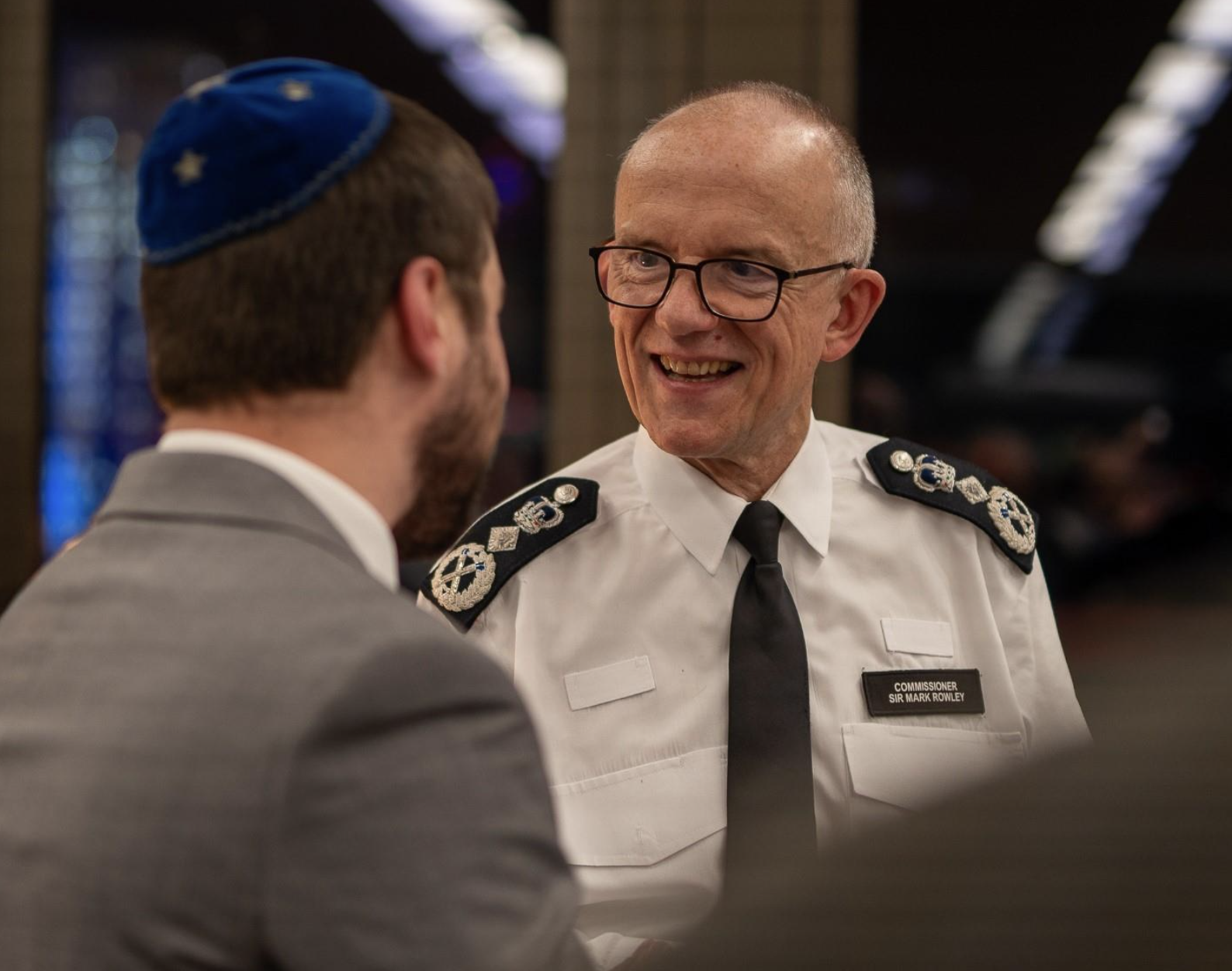
Commissioner Sir Mark Rowley welcomes officers, staff, and community partners to New Scotland Yard to celebrate Hanukkah. Source: Instagram
And precision is the point about the modern age and the British. We do not spend on policing what the Americans do, disappointingly. So we’ve got less resources, and we’ve got to be really sharp and precise in how we deploy it.
In terms of organized crime, there are a couple things to pull out. A big part of our serious violence and homicides over the years has been young men, particularly those associated with the drugs trade. And we are now down to the lowest number of young men homicides ever.
I don’t know how the drugs trade works in America, but over the last few years [in the UK] it’s moved very much into being sold more by mobile phone than on street corners. The dealer will put out, over a mobile phone, “I’ve got a load in,” and then all these customers will make orders and then the people running these—we call them lines—they’ve got kids who they’re grooming for the future who are running drugs for them. We’ve got some clever software that helps us get to the heart of those networks quickly. We find more than 80 percent of the people running the drugs networks are men of violence. They’ve got previous records for weapons and violence offenses. We’ve arrested more than a thousand of those.
We’re also identifying the kids who are running the drugs, because they’re more coerced into it, and putting them in social services to try to steer them off the path of becoming men of violence.
We’ve also done a lot of work on weapons availability. This might be hard to understand for an American audience, because weapons availability is so hard to have a real impact on in the American context. But we can impact upon it [in the UK].
This year we had the lowest number of firearms discharges we’ve ever had in London. Because it’s basically illegal to own a firearm in the UK, we bear down very heavily on that. We nearly doubled the number of firearms we seized last year. In London, it is hard to get a hold of a gun. Criminals will not routinely carry them. It’s not impossible, because they get imported and you can never suppress it down to zero. But we make it sufficiently hard.
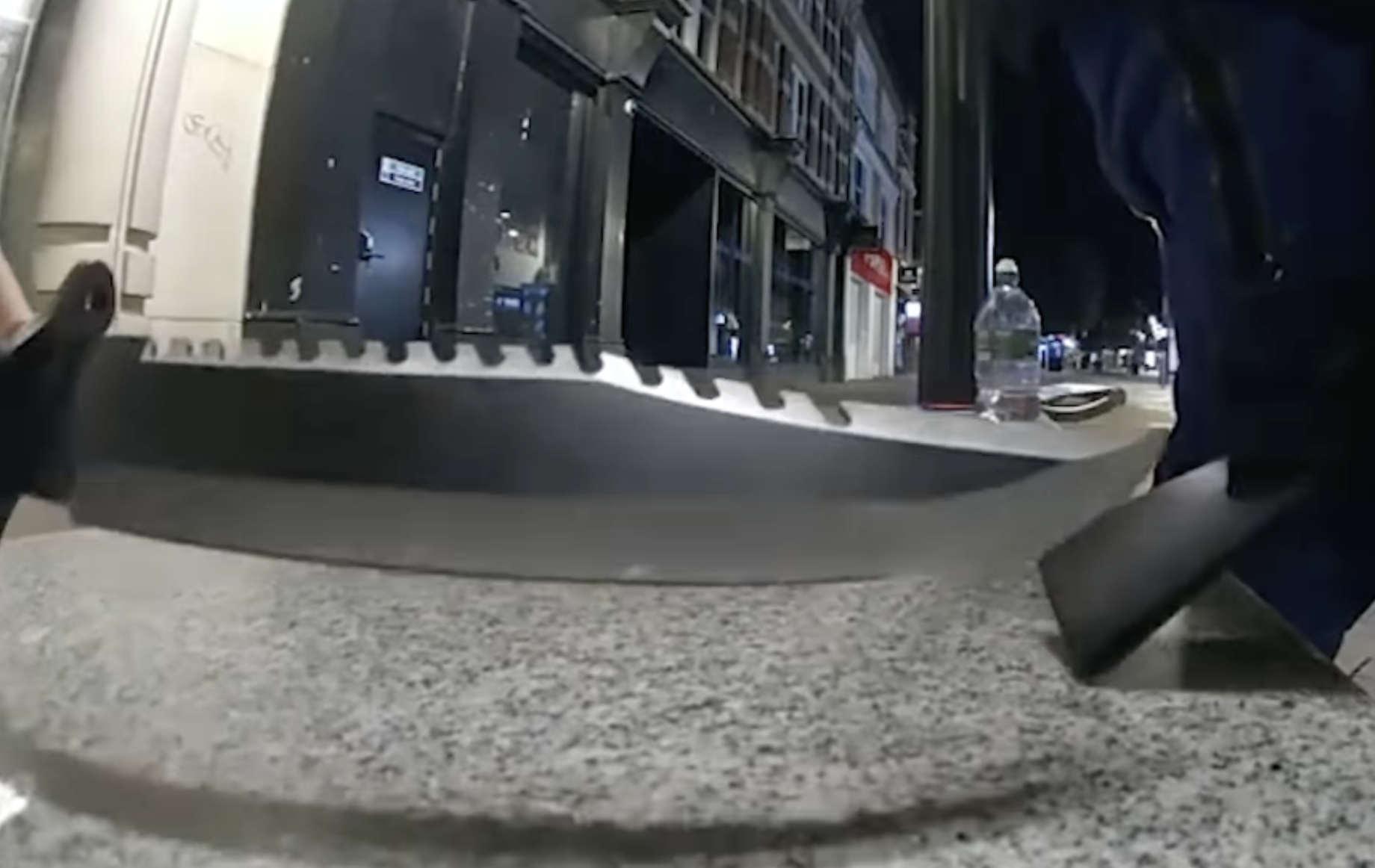
We’ve also nearly doubled the number of knives we’ve seized. A lot of our murders are knife-related.
A large hunting knife taken from a suspect in October 2025. Last year the Metropolitan Police removed 2,894 knives from London’s streets. Source: Metropolitan Police
Wexler: How are you addressing violence against women and children?
Sir Mark: It’s not all completely straightforward, but the vast majority of these cases are male predators and women victims. It’s not all that way, but that’s the big majority.
When I started as commissioner three years ago, I said that we were going to try to use counterterrorism methodologies to take on male predators. What I meant by that was I don’t think in policing anywhere in the world, we’ve been as determinedly proactive with the most dangerous male predators in the way we are determinedly proactive with terrorism or organized crime. You could walk into most big-city policing forces in the Western world and say, “Okay, who are your most dangerous organized crime groups?” and they would know who they are and they’d have operations against them.
We haven’t had the same approach of policing the men who pose the biggest risk to women and children in your city. We’re not as good at being proactive on that. There’s a whole history, of course, that we don’t get everything reported to us, and there’s the issue about building the confidence of victims to come forward.
But a reason we’re not proactive, it struck me, is the data challenges are enormous because there are so many reports, and you can’t sift through them all manually. So we’ve been using data science to create what we call the VAWG 100. VAWG is a UK acronym—Violence Against Women and Girls. We’ve been taking every offender we have down as a suspect for the last year or two, aggregating all the things we know about them, and coming up with relative scores to pick the top 100. With that top 100, we’ve created intelligence profiles, and we’ve looked at how we can get them off the streets and in prison.
There are three things we’ve done with them to step up our enforcement approach. The first tactic is to look at the cases you haven’t yet proven and asking if, with more effort or more support for the victim, you can get that case over a prosecution line.
The second thing is using preventative controlling court orders, like orders for offenders stating that they can’t go near this victim again, or they can’t go to this area, or sometimes orders about their access to electronics. We put these orders in place, then do surveillance, and if we catch them out, they go to prison.
The third thing is the “Achilles heel” or “Al Capone” approach. When you do an intelligence profile on the men who prey on women, you tend to find that they’re unpleasant and criminal in lots of ways. They’ll be drug dealers or street robbers or whatever else. So if we can’t get them in prison for the sexual assault or domestic violence, we can get them in prison for that. That gets them off the streets and sometimes helps the victims have comfort coming forward.
We’ve had the first 18 months of this evaluated by a couple of professors, Larry Sherman and John MacDonald. Their evaluation of what we’ve done, using a sort of a randomized-control type approach, shows that we’re reducing the harm caused by these men by about half compared to normal tactics.
Wexler: Tell me about the drone as a first responder program you’re launching.
Sir Mark: That got going over the last few months. We’re testing it around the center of London, and then we’re going to roll it out in due course. We see this very much as supporting front-line officers. It’s not covert; it’s overt. It’s even got a blue light on it. We’re trying to make it very clear this isn’t surveillance—this is helping first responders.
In the central zones of London, it can get to an incident within about 90 seconds, which is faster than your human police resources will normally get there. And it’s set up to be able to stream live footage from the scene. The program is only slowly building up, but this will be something we’ll build up a lot more over the next year.
Wexler: How are you responding to the threat posed by drones? In 2018, there was a notable incident at London Gatwick Airport in which reported drone sightings disrupted airport operations.
Sir Mark: The Metropolitan Police is responsible for policing London, but we also have some national responsibilities. One of those is to coordinate the national work against terrorism in the UK, working with our security service, MI5. As part of that, we work with the Home Office on investing in protective technologies and readiness things.
The Gatwick Airport threat you referred to prompted more investment. So we’ve got some really good technologies, similar to that used by the military. Experts in this will know it’s not possible to have perfect technology, but we’ve got pretty good detection technologies that we have found useful for most scenarios. And, of course, that is now part of our investment in our own drones, because you want to fly them safely. So your detection technologies make sure your own drones aren’t going to crash into anything that’s an important part of that safety infrastructure.
Wexler: You initially retired from policing from 2018 to 2022, and during that time you co-wrote a terrorism thriller, The Sleep of Reason. Did you learn anything from that process that helped you in your police work?
Sir Mark: I’ve got a good mate who I’ve known since we were teenagers who’s had a career as a journalist and now as a media trainer. He’s never worked in politics or crime journalism. On his 50th birthday, we’d partied and had too much to drink. At the end of the evening, we got into a conversation about thrillers and decided we ought to write one. Then we woke up the next day thinking, “Oh my God, what did I promise last night?” Then eventually we said, “Actually, no, we do really want to do it.” The founding idea was the growing interplay between some of the more toxic extremes of politics and extremism and terrorism, and by both ends of extremism and terrorism—the Islamist and the extreme right-wing end of it. The conception for the novel was a sort of dystopian political arrangement in London, with a difficult minority party and rising extremism all winding each other up into some sort of gruesome series of events. And the police in the middle were the heroes trying to save the day. I thought, “If the police can’t be the heroes in my own book, when can they be?” Doing something creative when you’ve been in law enforcement your whole life was very, very different, and I really enjoyed it. And doing a project with a mate who you’ve known forever is great fun as well. It was nice to create something. We’ve sold like 7 or 10 thousand copies. You don’t make much money out of it, but it’s a great thing to have done. And who knows, maybe I’ll make sequels when I retire again in a few years' time. But it’s a great, fun thing to do and a great Christmas present for friends of law enforcement. Thanks to Sir Mark for sharing his perspective with our members. Best, Chuck
|