|
February 7, 2026 Austin Chief Lisa Davis on immigration and managing change
PERF members, Lisa Davis became the police chief in Austin, Texas, in 2024 after spending more than 30 years with the Cincinnati (Ohio) Police Department. This week I spoke with her about her agency’s approach to immigration enforcement, how she’s trying to boost recruiting numbers, and how she’s managed the transition from Cincinnati to Austin.
Chuck Wexler: You recently wrote an op-ed in the Austin American-Statesman about your agency’s position on immigration enforcement. How is that issue playing out in Austin? Chief Lisa Davis: It’s been a learning process for me. The state has [enacted] Senate Bill 4, which basically states that employers, meaning the City of Austin, cannot prevent officers from cooperating [with] or responding to ICE. Adding a state law like that to your own policies is a little challenging. In the city of Austin, we don’t ask about immigration status. But in our general orders, we have to leave room to be in compliance with Senate Bill 4. So we say officers may contact ICE, but it’s not required. Those [are the] types of things we have to say. But the vast majority of our officers don’t contact ICE when they run into an administrative warrant, because those are civil [rather than criminal]. In February 2025, over 700,000 administrative warrants were entered into the NCIC system by ICE. So a lot of the confusion is the fact that these warrants are very similar in appearance [to detainers]. If you run both of them, an administrative warrant says, “call ICE;” a detainer also says, “call ICE.” So there’s some confusion there. I needed a policy that addressed those administrative warrants and how we’ll respond to those. When an officer does come upon that, they are to bring it to commander-level decision-making. I think the commander has a broader view of our priorities, and the priority of an agency that’s over 300 officers short is not waiting for ICE to respond on an administrative warrant. Unfortunately we had an incident where a lady and her five-year-old daughter were taken back to Honduras. There was absolute public outrage over that. But when you look at what the officer had to deal with, the administrative warrant looked very similar to a detainer, saying “you will call ICE.” At that point, the ICE agent decided to come out and pick this lady up.
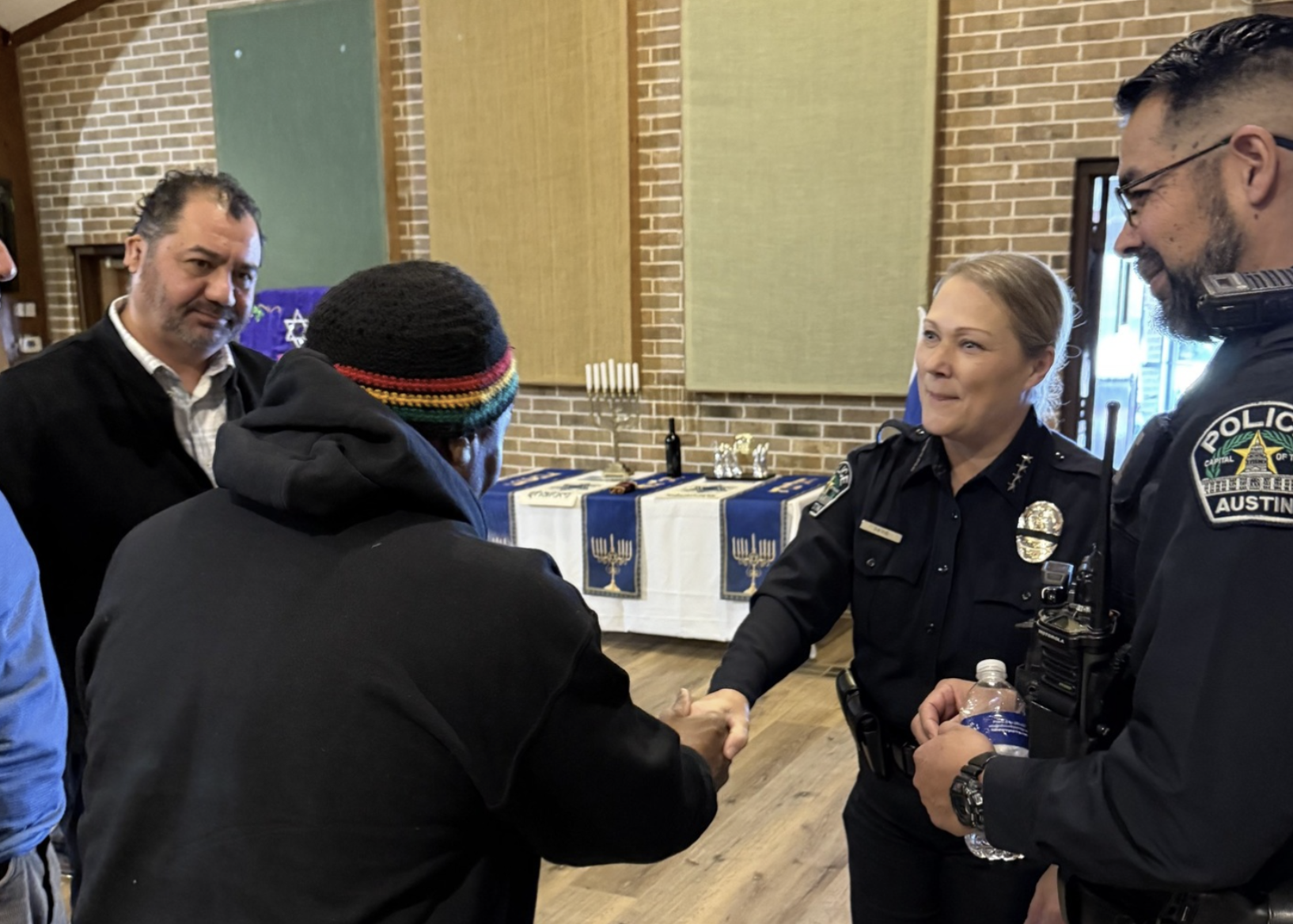
Austin Police Chief Lisa Davis meets with community stakeholders at the Alliance of Latin Ministries (ALMA) in January 2026. Chief Davis, along with Office of Community Policing Commander Lee Davis and Executive Community Engagement Lieutenant Marcos Johnson, spoke with community members about the department's procedures when handling administrative civil warrants. Source: Austin Police Department/Instagram.
Wexler: How did you handle that situation with the community? Chief Davis: I didn’t immediately call HABLA (the Hispanic Advocates Business Leaders of Austin), which I should have, because they’re the Hispanic leaders in the community. Waiting several days to do that was a mistake and a lesson learned. Going to meetings, there is real fear in the community. When you have a large immigrant population—Austin is over 30 percent Hispanic—there is real fear. We also know that this is a population that underreports crime. So trying to build that trust is challenging. And I understand the irony of this incident occurring and then coming back and saying, “please trust us, come report your crime.” It’s about putting things in place so people feel confident and comfortable contacting the police, certainly to report more serious crimes. We’re thinking outside the box by possibly involving our victim services to act as an intermediary to get people to report. We’re looking at bringing them in so they can talk to the victim first, then we bring an officer with the victim service counselor to assure them that we’re not looking at their immigration status. We’re not looking to see if they have an administrative warrant. That’s not what’s happening. Wexler: Have you noticed any reduction in the reporting of crime? Chief Davis: We had our Compstat meeting today, and domestic violence reporting has not decreased year over year. So that is good news, but we know that it’s an underreported group. Wexler: You came up through the Cincinnati Police Department, where Chief Tom Streicher saw the agency through one of the country’s first consent decrees. What do you remember of that period? Chief Davis: I think the way that consent decree was done was voluntarily with the FOP (Fraternal Order of Police), the Black United Front, and the city. So I don’t know that anything of its kind has been done since. I think within that period there were, I believe, a number of Black men who were killed. So there were high tensions in the city. Tom Streicher had control over the department and was well respected, but this was really challenging for him. It challenged everything about how we looked at policing and the way we did business, but for the good. The changes were hard. It took a while to change that culture within the department. It was at least five or six years before the culture changed, but it was for the best. And we were a city that was always on the cutting edge of things. That time was chaotic. It was scary. We had riots in the street. It was just complete chaos. But we came through it and we came through it better. The lesson is that when you bring people together—the advocates, the FOP, the city, all these different partners—we saw some serious change as a department. Wexler: What’s it been like coming from Cincinnati to Austin? Chief Davis: Austin is a lot bigger than Cincinnati. But I think when you’re making decisions about where you’d like to be chief and looking at what you want to do, everything is scalable to some degree. I was coming in with an idea of reducing violent crime. I knew how to do that in Cincinnati. I was the commander of District One, and I dramatically reduced crime there. So I thought I could bring my skills here to reduce crime. But I got here, and violent crime is not a real issue here in Austin. Austin’s a very safe city and has fantastic clearance rates. So I looked at what the department needed and pivoted to that. I had to understand internal issues that needed to be dealt with, like data and our reporting systems. I came in with one idea but quickly learned that reducing crime was not going to be my number one priority here. There were some systems within the agency that I needed to deal with first.
Chief Davis. Source: City of Austin.
Wexler: You mentioned you’re 300 officers short. Have you had trouble recruiting?
Chief Davis: I think recruiting remains a challenge to most agencies across the country. We’re having an individual come in in March to teach our recruiters how to be recruiters. I don’t know that they’ve ever been taught how to recruit. We have a military expert coming in to share that.
This year we’re actually starting to gain officers. So by the end of the year we’ll be about 280 officers short. So we’re making strides, but there’s always room for improvement when it comes to recruiting. We partnered with Texas State to hold testing within the system there. That’s working out well.
You want your police department to look like your community. So where are we recruiting women? Where are we recruiting Hispanic officers? Once we start asking those questions, I think we’ll be better off, especially with the training on how we recruit effectively.
We’re also looking at modified classes for people who already have a TCOLE (Texas Commission on Law Enforcement) license. If there are people who already have the qualifications, then you just bring them in for a few months of training. And you maybe bring them in at a pay level where they’re making more than they were in their previous job. But I’m not looking for someone else’s problems. I have to make sure that these people are well qualified for the Austin Police Department. But that’s something I want to look at to get our numbers up without decreasing our qualifications.
Wexler: In 2022, PERF completed an extensive report on the Austin Police Department’s response to sexual assault. I know that was before you were with the department, but can you tell me a bit about how APD has changed its response?
Chief Davis: It was before my time. I’ve been told that the PERF audit set the stage for changes that were made here in Austin.
Before the report, a lawsuit was filed by several women who had experienced really horrific responses by the Austin Police Department. So that had to change, and this lawsuit was filed. PERF was brought in to do an audit, and that audit allowed us to go to the city council and say, “These are the recommendations, and these are the changes we want to make.”
Our whole sex crimes response model was made based on those recommendations from PERF. Now we are looked at as an agency of best practice when it comes to responding to sexual assault. So I’m really proud of the work that they’ve done here.
Many police departments have organizations like PERF come in to audit and make recommendations. But if you’re not following the recommendations and taking that next step to get those done, what are you doing? The challenging part is taking that next step and putting those things into practice.
Wexler: Tell me about your new use of force policy and training.
Chief Davis: I wanted the use of force policy and every policy we have to integrate into ICAT. How do we ensure that each policy that touches use of force operates within the ICAT model? We know that ICAT saves lives and keeps officers safer.
I came in and looked at the use of force numbers and was just blown away by the reported number of uses of force. What I found is that every time they were handcuffing someone and they tensed up and pulled their arm away, it was counted as a use of force. You still need to count that, but it certainly isn’t a use of force.
We’ve been doing ICAT. We’ve focused on not just doing it through training but looking at how it works with every policy that can touch it. I focused on how we ensure that we teach those ICAT principles and de-escalate every contact where there’s the potential for force.
Wexler: It seems like you’re very happy to be in Austin.
Chief Davis: It was a big decision to leave Cincinnati. I’m from Cincinnati, and it’s a big deal to leave. My children and grandchildren are there. But I looked at this as an opportunity. I felt like my career was ending in Cincinnati, but I still had something to give law enforcement. This is a noble profession, and I still believe that. I looked at my skillset and thought, “I’m just not ready to walk away from policing.”
This opportunity came up. Austin is a fantastic city. It’s been a year of growth and challenges. It’s about surrounding yourself with a good team, which takes time.
Moving forward, I see myself staying here a while. I’m not putting a date on it; I’m looking at things I want to get accomplished. There are things I want to get accomplished before I start thinking about leaving.
It’s been a great ride and is a challenge every day, but is one that I’m glad I took on. Life is about adventure, and that’s what this is. It’s an adventure, and I’m having a good time while I’m learning a great deal.
Thanks to Chief Davis for taking the time to share her experience with our members!
Best,
Chuck
|