|
December 6, 2025 New PERF report helps police prepare for autonomous vehicles
PERF members, Two weeks ago, PERF released an extensive report on trends and emerging issues related to traffic enforcement. A chapter of that report discussed autonomous vehicles (AV), and today PERF is publishing a shorter stand-alone report on the topic. In my opening message in the report on traffic enforcement, I wrote about my first ride in an AV, earlier this year in Phoenix. “Caught between amazement and terror, I sensed a revolution in transportation was on the horizon and wondered if the implications had been fully contemplated,” I wrote. “Are AVs safe for a wide range of driving conditions? What are their risks? Will they change the rules of the road? Will travel times be affected? How should police agencies be prepared to respond? Can a police officer even issue a ticket to a car without a driver?” Five years ago, PERF and RAND documented the high-priority problems and needs related to AVs and law enforcement. In the years since, some police agencies have gained real-world experience with AVs. For this project, PERF spoke with police officials from Austin, Los Angeles, Phoenix, and San Francisco. These four cities are among the first in the United States with AVs on their streets, so their knowledge and experience can help the rest of the country prepare. We identified a few key topics agencies should consider before AVs arrive in their jurisdictions. Police officials said they are seeing some common traffic issues. “The vehicles have what’s referred to as opportunistic behavior,” Austin Police Chief Lisa Davis told PERF meeting attendees in May. “You might think they would stop on a dime and be very cautious, but they’re not.” AVs have trouble with irregular traffic situations, such as emergency vehicle traffic, road and lane closures, and verbal instructions and hand signals from police officers. Just this week, an AV in Los Angeles drove within feet of a man LAPD officers had ordered to lie face down on the ground after a police pursuit. According to NBC News, “The driverless vehicle could be seen in the video making a left turn and passing a white truck pulled over at the corner by several police cruisers with their lights flashing. The suspected driver was face down on the street at the time, the video showed.” In an effort to prevent this type of problem, police are working with AV companies to geofence areas that AVs should avoid. AV companies also generally provide law enforcement with a police number that can be called 24/7 to address any problems, as well as a way to contact a company representative through the vehicle itself. Meanwhile, what to do if an AV commits a traffic violation presents another challenge. Police officers generally issue traffic citations to the driver of a vehicle. There may be some situations where a citation is automatically sent to the vehicle’s registered owner instead, but most state laws do not account for the possibility of a car without a driver. In these states, law enforcement should make sure the state legislatures are aware of the problem. Agencies need to work with AV companies as they roll out their vehicles to identify and address this opportunistic behavior and any other potential problems. Police officials we interviewed said the companies generally do a good job of reaching out, usually using former law enforcement officers as the point of contact. Officers should be trained on what to do when they encounter an AV. Agencies may want to bring AVs to police stations to help officers understand the technology.
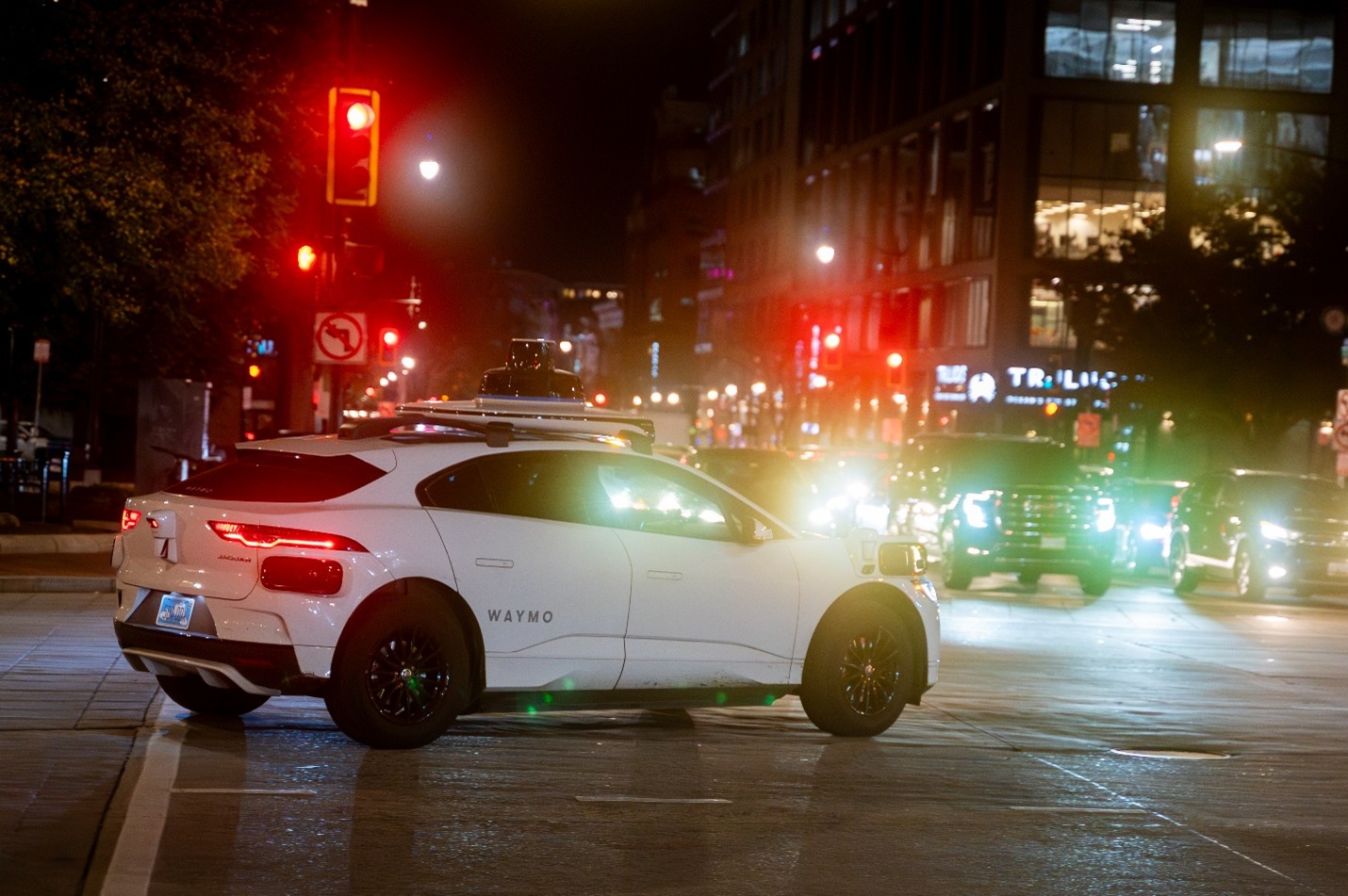
A Waymo testing on the streets of Washington, D.C. Only a handful of companies currently operate AVs, and police officials say they have the capacity to maintain relationships with those companies. But those officials are concerned that it will become more difficult to manage those relationships as AV companies proliferate, and they see a role for the federal government in setting industry standards. Several AVs were set on fire during a June protest in Los Angeles, raising questions about how to prevent and respond to vandalism and arson. Toxic gases are released when AV batteries burn, posing a threat to the public and to police. “We had three Waymos sent to the area impacted by the rioting,” Los Angeles Police Chief Jim McDonnell told PERF at the time. “[Protesters] lit them on fire, and the cars burned. . . . If [firefighters] were to go in and put water on the fire—which they wouldn’t, because they know what they’re doing—that would have created a toxic gas.” While AVs do pose some challenges for law enforcement, police officials said the issues have been largely manageable. “Overall, I would say it’s working, it’s just not pain free,” San Francisco Deputy Police Chief Nicole Jones told PERF meeting attendees in March. While more research is needed, there are encouraging signs that AVs are safer than human drivers. As we wrote in our report on traffic enforcement, there are approximately 40,000 traffic fatalities in the United States every year, making it the third leading cause of preventable injury–related death. I hope this technology will reduce that number and save lives. And despite those encouraging reports of AVs’ safety, individual incidents can capture the public’s attention. In just the past few weeks, instances of Waymo vehicles striking a dog and a cat have been the subject of extensive media coverage. I admit I find it a bit unsettling that human judgment is taking a back seat to a machine (pun intended). It will take time for society to adjust to this new technology. This is the first in a series of shorter reports by PERF staff members James McGinty and Dustin Waters that we will be releasing periodically, so look for more in the coming months! Best, Chuck |