|
May 30, 2026 Making in-service training relevant and timely, and remembering Charlie Connolly
PERF members, In-service training is part of every police department's DNA, but a recent PERF meeting and national survey show that it often falls short of both officers’ and executives’ expectations. Training can often feel like a department is simply going through the motions or checking the box, missing the mark of what officers really need. Officers sometimes perceive instructors as disconnected from the field. And the ongoing staffing crisis creates operational and budgetary concerns when sending officers for training. But the ever-evolving challenges facing the profession today—from technological transformation to changes in use-of-force practices and workforce shifts to increased community expectations—make relevant in-service training more necessary than ever. “There’s a massive and nationwide disconnect between the training police officers want and need to stay safe, and what they’re receiving,” according to Police1’s What Cops Want in 2025 survey. Sixty percent of 1,260 survey respondents reported training or qualifying with their firearms “rarely” or only once per year; 43 percent said their defensive tactics training is “ineffective” or “very ineffective;” and 82 percent said they “infrequently” or never receive scenario-based training. Last month, PERF brought together a cross-section of police leaders who are developing innovative ways to meet today's training demands.
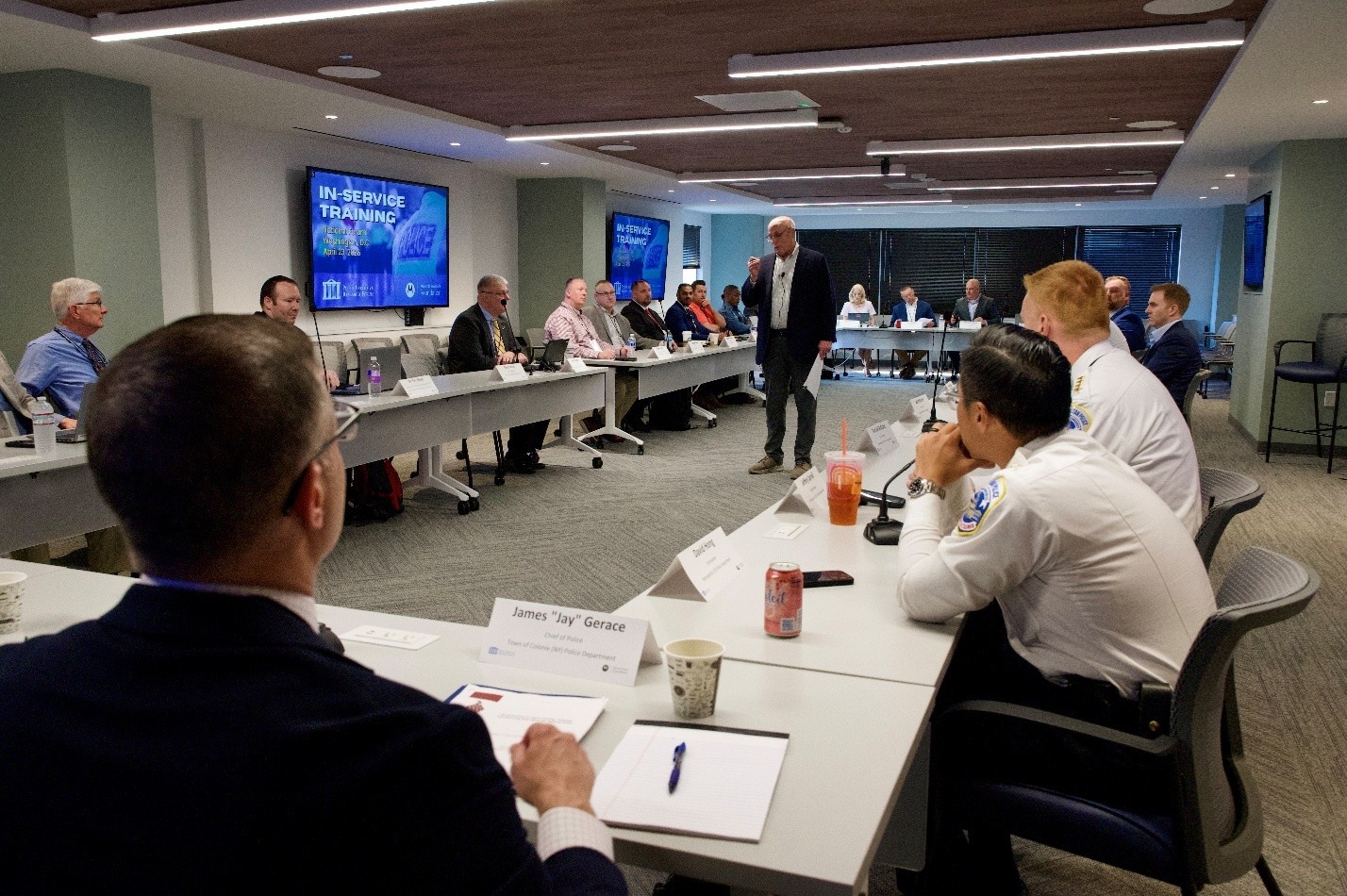
PERF’s meeting on in-service training, held April 23, 2026, in Washington, D.C. We kicked off the full-day meeting with these survey results and challenged the attendees to explain how the profession can better meet officers’ needs at a time when staffing shortages, inadequate facilities, insufficient funding, and limited training expertise constrain many agencies. They delivered many important recommendations, including the following: Increase training time. State training mandates range from 10 to 40 hours per year, and many agencies don’t require training beyond these minimum certification requirements. Many attendees felt one to five days of annual training is not sufficient to maintain officers’ proficiency on necessary skills, such as
To meet the challenges of policing in today’s environment of increasing demands and high expectations, agencies must find ways to provide more training than state commissions require. “Training ought to be more like an IV drip than major surgery,” said Dr. Gary Cordner, the Baltimore (MD) Police Department’s academic director. “A little bit at a time, over and over and over.” Analyze data to assess training needs. In an interview with PERF before the April meeting, Major Juan Balderrama shared how the Oklahoma City (OK) Police Department assesses its training needs: “[We ask] what happened [last year]? What failures did we have? What did we see out there that we're constantly doing wrong and we need to improve on?” Using data is essential for assessing agency risk, officer training needs, and community desires. When developing annual training plans, agencies should consider a wide variety of data sources, including the following:
Mobile training and “microdosing.” Bringing training to officers through mobile training units and patrol briefings can reduce the time officers spend away from their assignments and increase the frequency of training. Mobile training units are composed of three to five instructors who travel from assignment to assignment, delivering 30- to 60-minute modules of scenario-based training and skills-development exercises. Mobile training units empower supervisors and officers to train together in the environment where they work, thereby creating opportunities to reinforce policy, develop critical thinking skills, and build team coordination as they navigate real-world training scenarios. The Tucson (AZ) and Baltimore (MD) Police Departments have previously operationalized mobile training units, but they aren’t currently active in either agency. Another innovative example of field-based training is “microdosing,” which Chief James Gerace introduced to the Colonie (NY) Police Department in 2025. Microdosing integrates short, focused, and highly interactive training segments—oral recall, skills-based demonstrations, and tactical decision games—directly into daily patrol briefings to enhance officer readiness, drill perishable skills, and increase overall job satisfaction. An external evaluation of the program found it to greatly improve officers’ skill retention and decision-making confidence. Complement classroom training with online learning. Police agencies are meeting annual training requirements via online platforms more than ever before. Without a doubt, online training has its benefits: officers can take it between calls for service, commute time is eliminated, instructors aren’t needed, costs are dramatically reduced, and training resources can be easily shared. “We’re incredibly thankful for the online training option,” said Chief Jody Kasper of the Nantucket (MA) Police Department in a pre-meeting interview with PERF. “But I do wish it were more engaging.” Low engagement and intermittent attention are, indeed, among the many limitations of online training. Hands-on skill development, scenario-based learning, competency assessment, peer and instructor interaction, training integrity, instructor feedback, and team building are all compromised in an online learning environment. But online training isn’t an either-or proposition. Some training topics are well-suited for virtual learning, while others are better taught in person. Striking a balance between the two is likely to yield the best training outcomes. Leverage partnerships. Regional training can save time and improve efficiency. The Yuma (AZ) Police Department pools instructors and shares training facilities and curricula with other local agencies for training in firearms, defensive tactics, driving, and active-shooter response. This cooperation enables the area’s small and mid-sized agencies to drill core skills in ways they couldn’t on their own. In another interview with PERF before the meeting in Washington, D.C., Chief Dan Bentley of the Springboro (OH) Police Department discussed his county’s training partnerships. “We're all facing the same issues in Warren County: the training deficits, budgetary [deficits], whatever. [So we asked,] how do we combine those efforts and utilize the instructors that we all have? We may not have a driving instructor, but another agency has three. Now, we’re literally training with everybody in the county. County guys are training with city guys.” Hire civilian staff. Hiring professional, nonsworn staff (including retired law enforcement personnel) to develop lesson plans and deliver training can improve training quality and make sworn personnel available for other roles. The Baltimore (MD) Police Department has made civilianization a priority. Since entering a consent decree with the U.S. Department of Justice in 2017, the Baltimore Police Department has hired a cadre of full-time professional staff—a civilian academic director, several curriculum and instruction specialists, an athletic coordinator, two retired officers (from other agencies) who primarily teach recruits, and five seasoned prosecutors and criminal defense attorneys—to deliver more training than ever before. Prioritize a culture of training. Agencies should work to build an organizational culture that values training. This starts at the top, said Chief Tom Garrity of the Yuma (AZ) Police Department: “We have to lead by example, so the senior staff goes through the training with the officers because it lends more credibility.” An agency can create an organizational culture that values training by
Pursue a training ecosystem. Our background research and meeting made clear that effective in-service training requires an ecosystem with
Moving forward PERF’s 2022 report Transforming Police Recruit Training: 40 Guiding Principles concluded that the way police recruits are trained in the academy and the field has not fundamentally changed or kept pace with the dynamic changes taking place in policing. The same is true of in-service training. It often feels as though police face greater responsibilities than ever before but have less time to train on the skills and decision-making needed to meet those responsibilities. However, as I’ve detailed in this column, some agencies have found innovative ways to deliver effective in-service training. This summer, we will publish a full report that includes more extensive takeaways, additional comments from meeting participants, and the findings of a PERF survey on the topic. Thanks to the Motorola Solutions Foundation for their support of this important project and so many others! Charlie Connolly Former Yonkers, New York, Police Commissioner Charlie Connolly has passed away at the age of 90. Charlie joined the NYPD in 1957 and served there for 22 years, rising to the rank of captain. After leaving the NYPD, he led the Yonkers Police Department, then held senior security roles with the New York City Health and Hospital Corporation and Merrill Lynch.
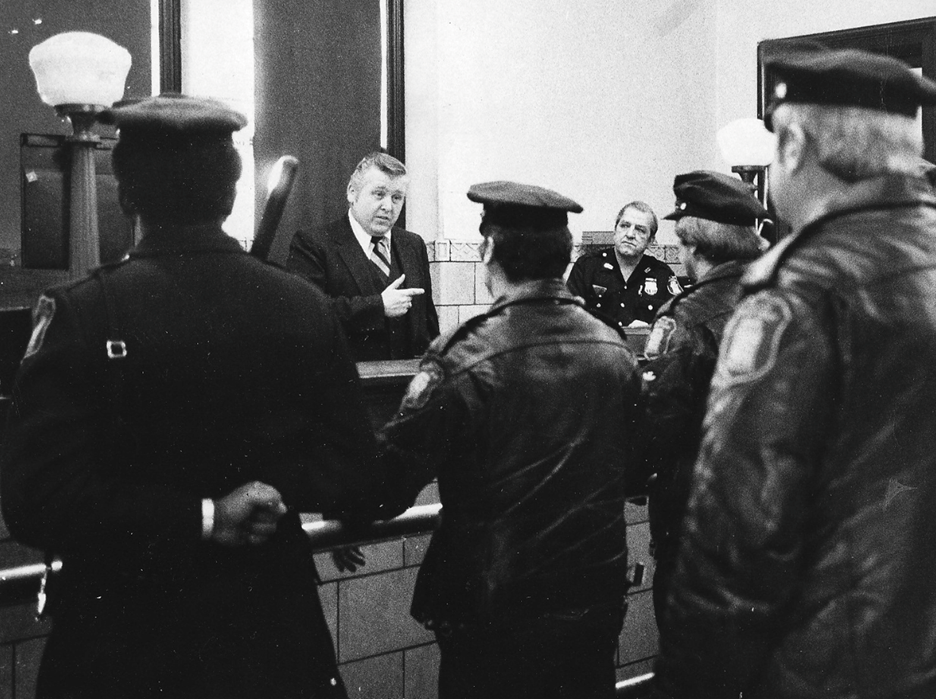
Yonkers Police Commissioner Charlie Connolly addressing roll call in the South Command (2nd Precinct), February 5, 1981. Source: Yonkers Police Department/Facebook Charlie was a regular at PERF’s Town Hall Meetings, and when he spoke, people listened. He was larger than life, an extraordinary storyteller, and extremely knowledgeable about policing. He made it a priority to get to know and advise every NYPD Commissioner, and if you asked him which one was his favorite, he would say, “the next one.” He was funny, he was diplomatic, and he had a heart of gold. Charlie was one of a kind and will be deeply missed. Have a wonderful weekend! Best, Chuck |