|
September 26, 2026 In a nation of immigrants, a common-sense approach to immigration enforcement
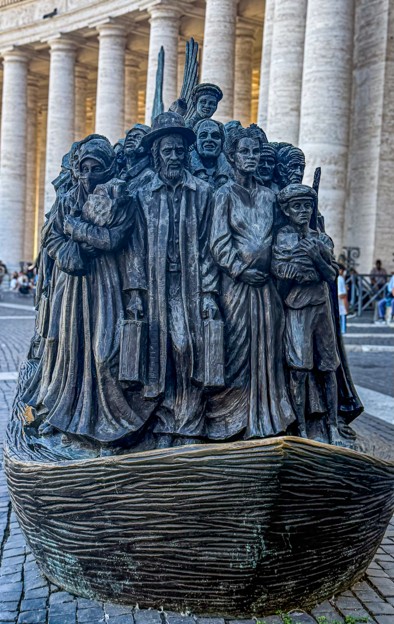
PERF members, While visiting Italy a few weeks ago, I discovered a relatively new addition to St. Peter’s Square in Vatican City: a bronze, life-size sculpture called “Angels Unawares.” It depicts dozens of migrants and refugees from different backgrounds and time periods, all huddled together, shoulder to shoulder, on a 20-foot-long raft. From the middle of this mass of men, women, and children emerges a pair of angel wings. Inaugurated by Pope Francis in 2019, the sculpture is inspired by scripture: “Do not neglect to show hospitality to strangers, for thereby some have entertained angels unawares” (Hebrews 13:2).
Standing there, 4,500 miles from home taking in this truly powerful piece of art, I was reminded of a simple truth. The United States is, and always has been, a nation of immigrants. Immigrants helped to build our country, and over the years immigrants have contributed immensely to our economic vitality and cultural richness. Many of us are the descendants of immigrants, people who came to the United States at different times and from different parts of the world. These people often had one thing in common: a desire to escape hardship, forge a better life, and contribute to their newly adopted country. The descendants of immigrants have always been a major part of the policing profession, with many cops coming from proud families who immigrated from Ireland, Italy, and other countries. That tradition continues today. A recent recruit class of more than 1,110 new NYPD officers included nearly a quarter who were born outside the United States; they represent 46 countries and speak 34 different languages. Many of today’s immigrants have followed a path similar to those who came before them. They have lived in this country for years, even decades. They serve in our military and on our police forces, work as nurses and clinicians caring for the sick and elderly, teach our children, plant and harvest our crops, build and maintain our homes and offices, prepare food in our restaurants, and perform countless other jobs that enhance the quality of life for everyone. Today, however, immigration has become a hot-button issue that is not only dividing the country but also challenging police agencies like never before. The police are tasked with enforcing the law fairly and equitably and protecting all residents, irrespective of their citizenship status. That is what builds trust with the community, which is a cornerstone of public safety. Yet local police increasingly are being pulled into the thicket of immigration enforcement. This is either happening directly, through formal 287(g) partnerships with federal agencies, or indirectly, by being called upon to provide crowd control and other support during federal operations. And when things go sideways, such as when a protest against immigration enforcement becomes a raucous demonstration, it is often the local police who are left trying to figure out what happened and dealing with the aftermath. It’s safe to say that immigration is among the most complicated and pressing issues that keep chiefs and sheriffs up at night. But it doesn’t have to be that way. What this moment calls for is not more overheated rhetoric or finger-pointing but rather a common-sense approach to immigration and immigration enforcement—one that makes our communities safer and maybe even helps to bridge some of the divisions that are pulling us apart. This approach has three critical elements: 1. Secure our borders. To safely and effectively manage immigration, the United States first needs to control who is coming into the country. This is squarely the responsibility of the federal government. It should dedicate the resources needed to secure our borders and prevent people from entering the country illegally. At the same time, the federal government should administer legal immigration, asylum, refugee, and guest worker programs judiciously and fairly, in keeping with American traditions and values and ensuring we have the skilled labor needed to support our economy. 2. Target serious, violent criminals. While the vast majority of immigrants in our country are law abiding, some do commit serious crimes, including crimes of violence. Identifying, apprehending, prosecuting, and holding these offenders accountable should be the focus of our immigration enforcement efforts. Removing these criminals will make our communities safer and help build public trust and confidence in the police. This is an area where interagency collaboration is essential. Local, state, and federal agencies have a track record of working cooperatively on a range of crime problems, including drug trafficking, human trafficking, and gun violence. On immigration, they should form task forces and other cooperative strategies that truly go after “the worst of the worst”—those individuals who are committing serious, violent crimes and causing fear in our communities. 3. Create options for long-time immigrants who do not threaten public safety. The reality is that most immigrants are not criminals, and their presence here does not threaten public safety. Many have lived here for years without any involvement in the criminal justice system. They hold down jobs, pay taxes, and support their communities through their economic and cultural contributions. Many fled brutal conditions and intense poverty in their homelands, and over the years they have become essential workers in cities and towns across the country, often performing jobs that others are unwilling to do. Yet, it is these very people—farm workers, nurses, hotel staff, even police officers—who are too often being swept up in immigration enforcement operations. These “collateral arrests” are concerning to the many neighbors and coworkers who value these immigrants’ contributions to their workplaces and communities. Many chiefs and sheriffs have told me that this is the most gut-wrenching aspect of current immigration enforcement efforts. Farm workers, hotel employees, or nursing home attendants who have worked in the country for years, made important contributions to their communities, paid taxes—they are among the people being swept up. Importantly, these collateral arrests are undermining public safety, not strengthening it. They have the effect of sending people into the shadows. Not only are these individuals less inclined to show up for work, shop in stores, or participate in their communities; they are also less likely to engage with the police. That means they are not calling 911 when they are victims or witnesses of a crime, and they are not cooperating with the police on criminal investigations, out of fear of being detained and deported if they step forward. When victims and witnesses, regardless of their status, go underground, crimes go unreported and unsolved, offenders remain at large, and communities become less safe. An unreported domestic violence attack today can easily spiral into a homicide tomorrow. Law enforcement needs to distinguish between the long-time, hard-working immigrants and the serious, violent criminals—and then focus their energies and resources on finding and apprehending the latter. At the same time, Congress needs to explore ways to allow long-time immigrants who are not a threat to public safety to remain in the country as productive residents of their communities. This means creating or expanding options that would allow them to live and work out in the open, without fear of apprehension and deportation. In his 1958 book A Nation of Immigrants, then–U.S. Senator John F. Kennedy traced the history of immigration in the United States and the strength that America derives from its immigrant roots. He was describing those families who came to this country inspired by the words of Emma Lazurus in her famous poem The New Colossus—words that are etched on a plaque at the base of the Statue of Liberty: “Give me your tired, your poor, The 250th anniversary of our country is a time to celebrate American greatness and to acknowledge that America is great because we have always been a nation of immigrants. Throughout our history, we have welcomed those fleeing oppression, violence, and poverty and striving to build a new life in a country that offers freedom, safety, and opportunity. For decades, America cultivated the image of a welcoming nation for those seeking a better life. Today, we have the opportunity to recommit to that ideal. We need to recognize and applaud the important contributions immigrants have made—and continue to make—to our country, including to the policing profession. And we must find common-sense options that allow people who have lived here for years and who pose no threat to public safety to remain as productive members of their communities. We will be a better and safer and stronger nation for it. Best, Chuck |