|
July 25, 2026 Palm Springs Chief Andy Mills reflects on nearly 50 years in policing
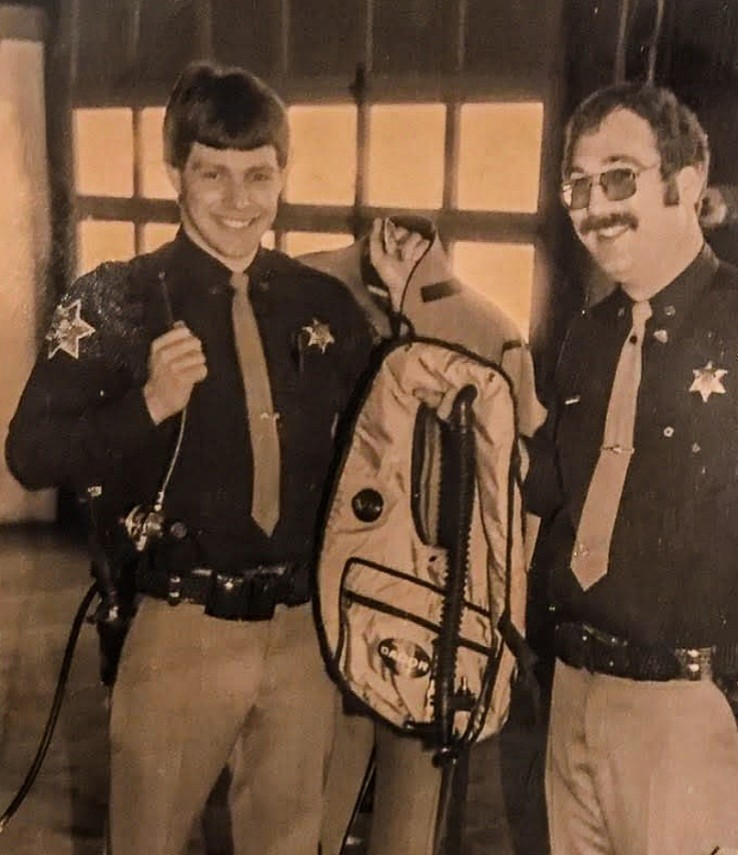
PERF members, Chief Andy Mills is retiring from the Palm Springs, California, Police Department this September after a distinguished 48-year career in policing. His first law enforcement roles were in Michigan with the Branch County Sheriff’s Office and then the Battle Creek Police Department. He then moved to California and joined the San Diego Police Department (SDPD) in 1983 and served with that agency for the next 30 years, retiring as a captain. After leaving SDPD, he served as chief of police in three California cities—Eureka from 2013 to 2021, Santa Cruz from 2017 to 2021, and Palm Springs since 2021. Chief Mills received PERF’s Gary P. Hayes Award in 2000 and led a team that won the Herman Goldstein Award for Excellence in Problem-Oriented Policing. I spoke with him this week about problem-oriented policing, moving from a large agency to a smaller one, organizational culture, and his advice for other police leaders. Chuck Wexler: Where did your law enforcement career begin? Chief Andy Mills: I grew up in Michigan and was a cop in Michigan, first with the tiny little Branch County Sheriff’s Department, where I was a marine deputy driving a boat around. I thought I was absolutely cool—Baywatch in the Midwest—and learned really quickly that I had no idea what I was doing. Andy Mills (left) while serving with the Branch County, Michigan, Sheriff’s Office. Source: Andy Mills/Facebook. Then I went to the Battle Creek Police Department and was there for a pretty short period of time—almost two years. I decided I needed to go back to finish up school, and I did. I met my wife in the meantime and had a choice between Michigan and San Diego, California. The choice wasn’t too tough. I figured it out pretty quickly. Wexler: You then spent your formative years with the San Diego Police Department and became an expert in problem-oriented policing. How did that come about? Chief Mills: I had two men come with me on a ride-along—[former PERF research director] John Eck and [the late University of Wisconsin-Madison Law School professor] Herman Goldstein. It was during the days when [the Bureau of Justice Assistance] was funding problem-oriented policing pilot projects. San Diego was one of the pilot projects. John and Herman sat in the car with me for 10 hours and asked very inquisitive, thoughtful questions that made me think. I remember distinctly going to a “shots fired” call at 1600 Pentecost [Way]. We jumped out of the car, did our cop stuff, and got back in the car. Herman asked, “How often does this happen here?” I said, “Well, pretty much nightly.” Herman said, “But why here? Why not that apartment complex over there?” It kind of dawned on me that I had no answer as to why crime was occurring at this location and not that location. I asked, “Well, why do you think that is?” And he started explaining underlying conditions and what to look for. And John, of course, wrote the seminal article on crime clustering by victim, suspect, and location. I started thinking about the bigger idea of problem-oriented policing. It made so much sense to me that I felt it would be something that would be interesting to get involved with and push forward. I wound up getting very involved with PERF and your problem-oriented policing conference in San Diego. I met you and many others through that, and it really changed the trajectory of my career. Wexler: It’s very fortuitous that the three of you met, because you all had a huge impact on problem-oriented policing. Chief Mills: I think they were able to give the academic side and tell people how [it works]. And I was able to say why it’s important for policing. We did a lot of traveling back then. PERF was very involved. We went to hundreds of departments to do training, and I was able to spread the message that this could be a more effective way of policing.
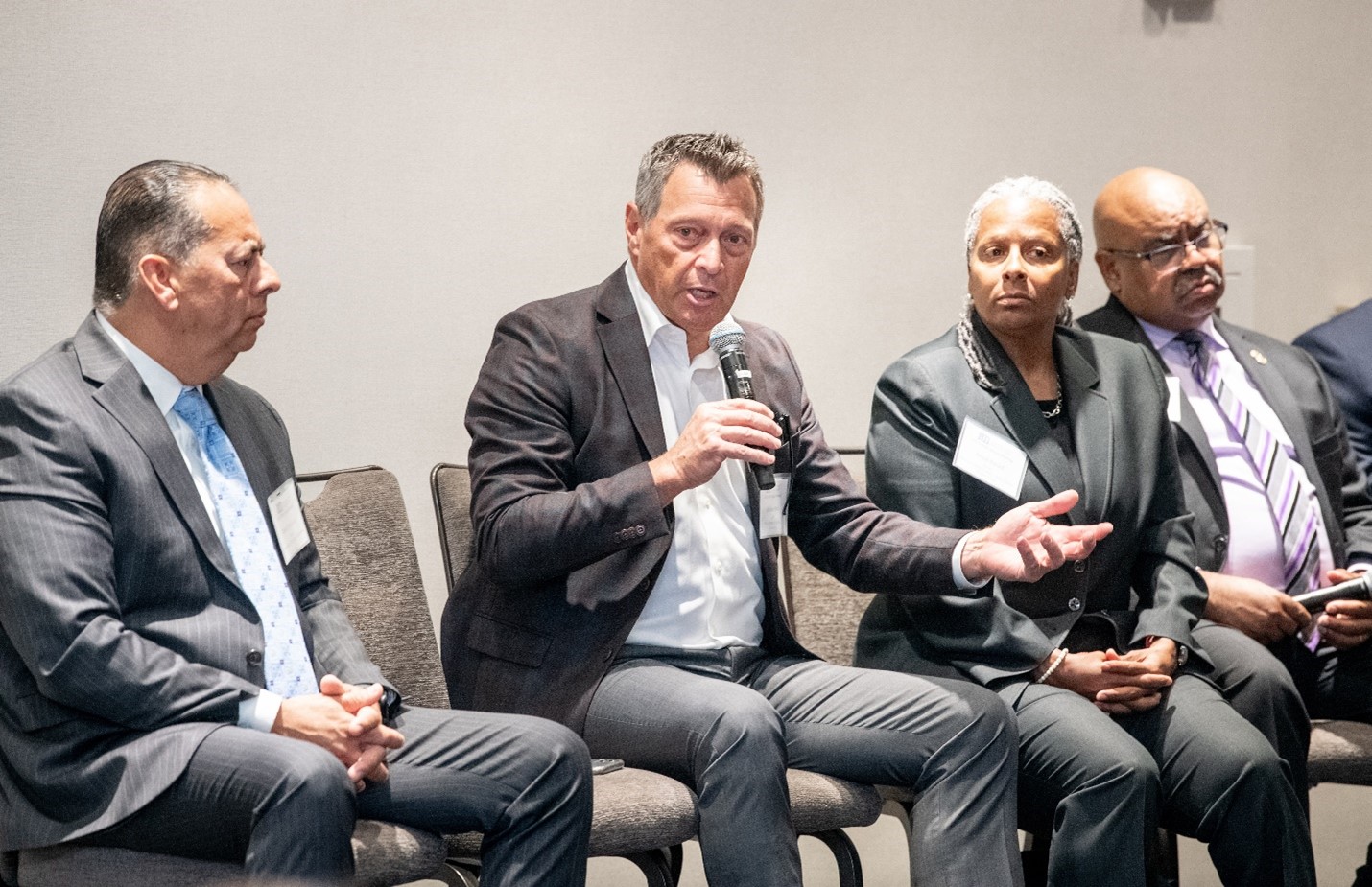
Chief Mills speaks at the 2023 PERF Annual Meeting. One of the things I consistently ask my command staff today is, “What strategy are we using to reduce crime?” The NYPD has done a great job of that. They come up with these big strategies and big theories. It has worked sometimes and other times it hasn’t. And San Diego had a strategy when we saw that massive decline in crime in the ‘90s. Those two departments led the nation. I still see a lot of police agencies that don’t have a specific strategy that they’re using to reduce crime. Wexler: And you were recognized with PERF’s Gary P. Hayes Award in 2000 and the Herman Goldstein Problem-Oriented Policing Award. Chief Mills: Obviously it takes a team to get those awards. For the Goldstein Award, I had a team working for me at the time who saw the bigger picture and got the ideas. We had people who were willing to experiment, be innovative, and really look hard at the data to figure out the best way to reduce some of these problems. So I had a great team behind me. The Gary Hayes Award was a little different. There were people like yourself, Herman, and John Eck who were able to guide me. I have a tendency to be a little bit outspoken about progressive thought in policing. I wrote a couple articles back then. A guy I went to the academy with—Harvey Love, who is still a dear friend to this day—was stopped once a week on the way to work by the [California Highway Patrol]. He is a Black man. I drove exactly the same path at exactly the same time, often at the same speed, and he got stopped and I didn’t. We wrote this article about Black and White in America. That was in the ‘90s. We had a very interesting discussion about why he was getting stopped and I wasn’t. I learned a lot from Harvey. When he was on his way to take the test for the San Diego Police Department, he was stopped by another law enforcement agency and called the N-word over a loudspeaker. He said he almost didn’t take the test, but he thought, “No, I’m going to change this from the inside.” So that’s what the article was about. I think those kinds of things are important for policing, to spur future leaders to take a risk and speak out. It’s too easy to sit back in our jobs and just play it safe. Policing needs strong, capable leaders who are willing to speak out on stuff. I’ve done that most of my career, and I think it’s paid off for me. Wexler: You left the San Diego Police Department to be the police chief in three smaller departments. What was that transition like for you? Chief Mills: I think the biggest difference I saw was that in a smaller agency, it’s all personal. You know everybody. Everybody interacts with one another. You know their families. You know where people live. You’ve been in a car with someone for years. Then an outsider comes in, maybe with different ideas, and they’re not part of the family. As a chief, you have to navigate that. Because if you promote one person and not two others, those two are going to be upset. And it’s all personal. So I had to find a way to depersonalize things, but still keep that family atmosphere. I think that was probably one of the biggest challenges for me to adjust [to].
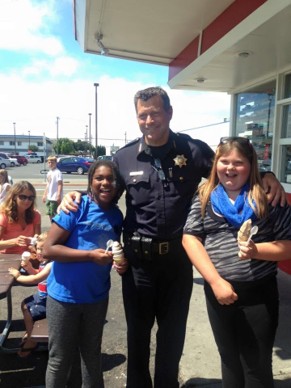
Chief Mills enjoys some ice cream with Eureka community members in October 2015. Source: Eureka Police Department/Facebook. Because in the San Diego Police Department, you’re listening to other captains say, “This is a fantastic person. I think they would be a great person to promote. Here’s the downside and the upside.” You sometimes have no idea who the person is, yet you’re still trying to figure out who gets promoted. Wexler: How do you assess the organizational culture when you arrive in a new agency? Do you try to change that culture? Chief Mills: My first chief job was in Eureka, and I apologize to all the Eureka cops who might read this. I was so familiar with and comfortable with and proud of what I accomplished in a large department that I tried to make it a little San Diego PD. And it’s not. It’s a different culture, a different lifestyle, and different ethos. They are very good at what they do for that community. So I had to learn pretty quickly that it was not San Diego and it couldn’t be San Diego, but what they did was very special for that community. Then I had to work through their culture and be comfortable with that, not make it my own. At the same time, there’s a reason they’re bringing an outsider in. You want to make sure that you’re doing what’s innovative, successful, reducing crime, and making that community feel safe. You have to make sure that you’re bringing innovation to the table and changing the sometimes not-so-good parts of the culture in those organizations without destroying the overall atmosphere. Wexler: Palm Springs is a progressive community and I suspect that your police officers, like most officers, are more moderate or conservative in their views. Is that a challenge? Chief Mills: The people of Palm Springs frequently view their community as a blueberry in a sea of red. This is a very conservative county, but Palm Springs is a very progressive community. Our officers, like many officers in the nation, are pretty conservative in their ideology and viewpoints. So mixing the two together can be challenging. When I first got here, the Police Officers’ Association (POA) was at loggerheads with the city council over policy and who they were going to support. They were doing billboards against one another, and it was just a terrible situation. I sat down with the POA and said, “You’re not going to win this fight. Let’s get out of the business of politics and get back into the business of crime fighting.” They listened, de-escalated the argument, and won the council over, because they actually focused on crime fighting and understood that we needed to adhere to the policies of the city government. The officers have the absolute, unadulterated right to support and vote for whoever they want to. But when they police, they need to be absolutely neutral, genuine, and caring about our community. And our community gets that. They see our department as supporting them personally. We’re about 60 percent LGBTQ in our city. And this LGBTQ community has been the most supportive community I have ever policed in, by far. It’s not even close. Because our officers support them and they support our officers back. I think the winning combination is when people truly feel supported, regardless of their personal beliefs. That doesn’t matter to our folks—we just go out there, do our job, and do it well. That’s how you build those relationships. As a result, the most common thing I hear from all parts of our community is, “Chief, what do you need? What can we do to support you?” That’s because our officers have done a great job. When there is a crisis, the officers step up and support our community. When there’s a crisis inside the department, the community steps up and supports our officers. So I could not ask for anything more. Wexler: You’ve had an almost 50-year career in policing. Is there anything else you’d like to say about the profession? Chief Mills: This has been such a phenomenal ride. I have enjoyed literally every second of it. I have never woken up a single day when I didn’t want to come to work, and that is saying something. There are storm clouds on the horizon, though, that I want other chiefs to think about. Technology is putting us in a fabulous position. It is really helping us be better at what we do in terms of finding and arresting criminals. Right now, there’s a little bit of a backlash, but this technology is a tool that we all should be working to proactively protect. And I don’t see that across the nation. We need to make sure that we have the right audits, policies, transparency, and oversight in place. I encourage my fellow chiefs across the nation to put the policies together proactively. Let’s be as transparent as we possibly can be, so that we can continue to push this forward. Because I honestly believe this will make our community safer. One of the things I’ve seen in my career is that we are pretty good at reacting to stuff, but we’re not that good at proactively preventing some of these problems from arising. That’s why it’s so important to have the Police Executive Research Forum and others in place to help us think more broadly about these issues and put the research behind it. That makes us more thoughtful and better.
Chief Mills playing pickleball at a charity event with the local professional team. Source: Andy Mills. Congratulations to Chief Mills on a well-earned retirement, and I greatly appreciate him taking the time to share his wealth of experience with our members! PERF is very fortunate that Andy Mills was the cop who was selected to drive John Eck and Herman Goldstein around San Diego. Out of that relationship grew a long-term partnership between PERF and the San Diego Police Department that inspired countless police departments to implement problem-oriented policing strategies to address everyday crime issues. They also identified innovative leaders to share best practices at PERF’s annual problem-oriented policing conference in San Diego. And those strategies reduced crime and chronic neighborhood problems. Andy Mills was at the center of that work, and his contribution to policing has been enormous. Best, Chuck |