|
January 24, 2026 Las Vegas Sheriff Kevin McMahill discusses the unique challenges of policing the world’s entertainment capital
PERF members, Las Vegas is a city unlike any other. To learn more about what it’s like to police a city that’s bustling 24 hours a day and used to advertise with the slogan “What happens here, stays here,” I spoke with Sheriff Kevin McMahill of the Las Vegas Metropolitan Police Department (LVMPD). A U.S. Army veteran, McMahill joined the LVMPD in 1990. He has served as sheriff since the start of 2023. I recently heard him tell a local reporter that he’s “failed” in his efforts to reduce traffic fatalities, and I was impressed that he took responsibility for the daunting challenge of reducing traffic deaths. I wanted to speak with him about his agency’s approach to traffic fatalities, community policing, and investigating violent crimes. Here is our conversation. Chuck Wexler: Las Vegas is a one-of-a-kind city. What makes Las Vegas different from other cities from a policing standpoint? Sheriff Kevin McMahill: We have about 2.5 million residents here. But we have upwards of 50 million visitors every year. So on average, every couple of days, 300,000 or 400,000 people who are visiting change out. And you know, a marketing group came in and started the “What happens in Vegas, stays in Vegas” mentality. That’s [led to] a lot of people coming here and doing things that they wouldn't do in their own hometown. So I think that's probably one of the things that is different than just about everywhere else. But the other piece of it is we're truly a 24-hour town. In fact, a lot of our clubs don't start partying until about one o'clock in the morning, when most other cities are shutting down. Most of the casinos have security forces that are larger than most police departments in our country, so we have unique relationships with them. We train with them, we share intelligence with them, and we utilize each other's technology.
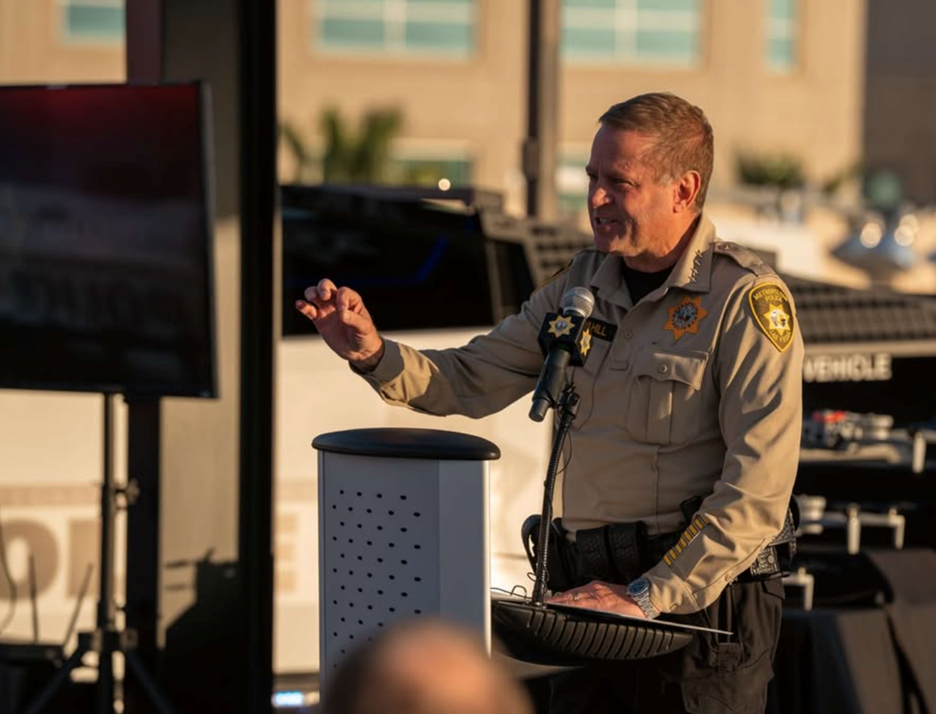
Sheriff McMahill at the unveiling of the new network of LVMPD Skyports and newly redesigned Fusion Watch and Drone Operations Center. Source: LVMPD Wexler: You told a local news station that you've “failed” on traffic fatalities. For someone to say that is, number one, very honest. Number two, it assumes that you can do something about it. Talk about how you're addressing traffic fatalities. Sheriff McMahill: I think this is a great example of what you can and can't do. I have 160 people a year dying in traffic fatalities. A lot of what got me interested in this in the first place was that I started a Wellness Bureau at [LVMPD] where I converted seven police officer positions into clinician positions and hired those clinicians. What I realized was that there are lots of places in the police department that we don't pay attention to in the same way that we do for a patrol cop that's out there handling calls as they occur. One of those areas was the traffic fatality detectives. You can imagine going out year after year after year to 160 people dying on your roadways. Those poor detectives have to see bodies mangled and destroyed. We as leaders have an opportunity to stop having them be subjected to that much trauma year over year. I realized we're failing at it. It's not solely a police responsibility to drop traffic fatalities. I thought other people would have the same concern about human life that I did. Our legislature was more concerned about the failures of automated traffic enforcement in other cities. They were concerned about it having a disparate impact on minority communities. They were concerned about Big Brother being out there. Never mind the fact that we have traffic cameras on every light pole at every intersection today. I think people need to realize that they're getting into cars that weigh thousands of pounds and their bad driving behavior is causing other people in our community to lose their lives. We have an environment here in Las Vegas where the roads are wide open. They're built for cars to drive fast. So we have to do something about it. The other piece of this is that the decriminalization of the vast majority of traffic offenses has not had a good impact on offender behavior. It's had some unintended consequences. There's no accountability in the court system for traffic offenses, and that's something else that has to change. Our multi-prong approach is having a tremendous impact. We started what we call a “Life Squad” of traffic, where we're taking patrol officers and pairing them up with traffic officers. We've had a 54 percent decrease [in traffic fatalities] over the course of the last three months when those life teams are out targeting the offenses that are leading to traffic fatalities at the locations where we know that they're occurring. So we're seeing some early success. The other part of this that's really fascinating is the automated vehicles that are already operating. I believe that technology is really going to truly help us eliminate these traffic fatality accidents or reduce them to a point where they're almost not occurring. It won't matter what the driver’s intoxication level is. If this full-service driving ever gets to the place where I believe a lot of people think it's going to get, I think there's a lot of benefit from its impact on people dying on our roadways. Wexler: What can you tell me about violent crime? Sheriff McMahill: We took on two areas that I'm particularly proud of. Number one is the homicides. Three years ago, I challenged my organization to reduce violent crime and homicides. When I took over as the sheriff, we had 158 homicides the prior year. Ending last year at 88 is obviously a tremendous reduction. I gave them the goal to get under 100. When law enforcement leaders give our people an opportunity to reach a goal and constantly strive toward that goal, that's a huge way as we move forward. I think it's really important to note that our homicide section has had a solid clearance rate of 95 percent or better for years and years. As we sit here today, we're at 96.8 percent [for 2025]. What we did over a decade ago was change Homicide from having the mentality that the case was only theirs. Previously when a homicide occurred, Homicide showed up, and they directed everything that happened with their homicide. Homicides happen in neighborhoods where our patrol cops are working and engaged with our community members. Homicide typically isn't involved in any of that. So we started a whole agency approach, where the area commander is the one who dictates all of the things that happen around a homicide. Homicide still does their exceptional work, investigating the homicide, and is led by exceptional leaders who ensure that we solve all these cases. As a simple example, when we were first trying to change this, I had 13 shootings in the west part of Las Vegas with a zero percent solve rate. So I opened up the case to the patrol cops. The Homicide detectives were looking for a particular white van that had a unique window on it. And the patrol cop I sent over there reviewed the case and said, “Oh, I know whose van that is.” So that was the first homicide we solved by opening the homicide file to the patrol cops who work those neighborhoods. Wexler: Is that one of the key things that you did that has impacted your clearance rate? Sheriff McMahill: I believe that's at the very top of the list. Nobody knows a neighborhood better than the police who are out there policing it, with one exception—the people who live in that neighborhood. I changed the philosophy and the direction of our community policing. I think a lot of people have gotten away from understanding what community policing is. It's a buzz word. If you look at every website of every police department across this country, they all say, “We're a community policing organization.” But what does it mean? I came up with the phrase “injecting humanity.” We inject humanity into all it is that we do. Meaning, if we take George Floyd as an example, you can argue whatever you want to argue about George Floyd, but there's no humanity in kneeling on a man's neck for nine minutes. I have a paralyzed police officer from the protests in 2020. He breathes out of a tube. He was shot during those riots because of the actions of Derek Chauvin in Minneapolis. Inject humanity. Don't let your partner kneel on a man's neck. It's just not right. As with Rodney King and all the cases in between, if we had just paused long enough to do that, I believe that we would have a different outcome in a lot of these situations. Now, we still make mistakes. I want to be clear about that. We're not a perfect organization. We still make mistakes. You have to follow the “mess up, fess up” model to have any legitimacy with the people in your community. But we always had these headquarters-driven community policing strategies, meaning Shop with a Cop or whatever else we wanted to do. I decided that community policing should reside within each of our area commands. Today we have 10 commands, and soon we're going to have 12. How do you get out and develop relationships in those communities? Wexler: How are you addressing nonfatal shootings? Sheriff McMahill: While we had a success with our homicide clearance rates, when I looked at nonfatal shootings, I had a 30–40 percent clearance rate. If the shooting was related to gangs, Gangs investigated it; prostitution, Vice investigated it. Whatever group it was involved with, that's who was investigating—not the same whole-of-agency approach that we used with homicides. So I re-centralized all those detectives and appointed exceptional leaders. I did that year ago in September. The more than 200 cases that they investigated over the course of that year had a very high solve rate. It’s been so successful that I added two additional squads, so I now have 40 detectives, four sergeants, and a lieutenant investigating all these shootings. The reasoning behind this is that we know that if an individual is shooting somebody, it's just a game of inches. The victim could have died. The idea is to get these individuals who are willing to pull the trigger and shoot another human being off the street. We're having great success and putting these people who have shown the willingness to shoot another human being in prison. (Note: This was a recommendation in PERF’s 2025 report on prosecutor-police partnerships.) Six out of 10 of them were getting away at one point, and then we were shocked to find out that they were involved in multiple shootings and ultimately a homicide. We're not seeing that at the same levels that we were. The violent gun crime unit has been particularly powerful in helping drive the crime rate reductions that we've seen over the last three years. Wexler: In January 2025, you had the explosion of that Tesla Cybertruck. You said that investigation found that ChatGPT was used to identify possible targets. Tell me in your own words, how was ChatGPT involved? Sheriff McMahill: It was the first time that we had really become aware that a suspect was helped by utilizing that form of AI to determine a variety of different places where they could conduct the type of attack that they wanted to conduct. As we were going through the devices and looking at the history, we were able to determine a variety of different places that he had intended to go and what he had intended to do. He would ask ChatGPT questions, and he was getting almost feedback, like you’d get from another human being, as to what he was thinking about doing, and chat GPT was providing answers to him. Wexler: You recently announced a new drone operation center. What is that all about? Sheriff McMahill: We had 38 drones donated by [venture capitalist] Ben Horowitz, who moved to Las Vegas from California and wanted to spend his billions. He decided he wanted to help us become the most technologically advanced police department in the world, because he thought that technology could have a tremendous impact on our ability to solve crime and, ultimately, prevent crime. So he bought these drones. I took our real-time crime center, where all of our technology is—LPR, facial recognition, Shot Spotter, etc.—and turned it into a drone operation center, so everything is connected to it. We're the first agency in the country that can fly four drones at one time. We were one of the first agencies in the country to fly beyond visual line of sight. And we're the first in the country to fly in restricted airspace, in and around airports. We were able to get all of that because of our relationship with the FAA and by demonstrating our capabilities to them. I now have a drone pilot center at headquarters. When a call for service comes in, the pilot can press the button, the drone will go up, go out to the scene, hover overhead until the drone pilot takes control of it, and then they speak directly to officers in the field via radio. They can provide real-time intelligence to the cops as they're responding. These drones are often getting there within seconds.
Over 10,000 LVMPD drone missions were flown in 2025, all tied to calls for service. Source: LVMPD Wexler: On the drone mitigation issue, Las Vegas—much like Washington, D.C., New York, Chicago, and L.A.—is a potential target of a drone attack. How do you think about that? Sheriff McMahill: Drone mitigation is really at the top of the list for us. When you designate something like the Super Bowl, an F1 race, or a New Year's Eve event as a SEAR (Special Event Assessment Rating) 1, 2, or 3 event, you get federal support. But the federal support is never going to be out on the front line utilizing the drone mitigation that you're going to need if there's an imminent threat. So we've had lots of conversations about what we’re going to do, and how we’re going to do it. Luckily, I know the White House is listening. The FIFA soccer tournament is going to be in many major American cities very soon. The White House opened up drone mitigation training to a number of local agencies, starting with all those FIFA host cities. Because of the threat to Las Vegas, we were also able to send an individual to the training. There are a lot of challenges around this, because you can't just simply send up the radio frequencies to jam the thing, especially if you're in restricted airspace. So net guns and a variety of other things are being explored. But we are far behind where we need to be. Quite frankly, it's just terrifying, because it's just a matter of time before we see what you've seen in Ukraine here in the United States. Wexler: What's the most fun part of being the sheriff of Las Vegas? Sheriff McMahill: I have 6,200 employees now. I have thousands of police officers who come to work every day to make a difference. I know that they matter in our community and getting to lead them, push them, prod them, motivate them, and inspire them to go out there and do the things that they do day in and day out—that's the greatest joy that I get from my professional life. They're eager to go out and prove they can do these things. They're solving what typically, in the past, would have been unsolvable cases. Thanks to Sheriff McMahill for taking the time to speak with me. I’m impressed by the way he takes his job to heart. Best, Chuck P.S. I encourage you to register for the 2026 National ICAT Conference, which will be held February 9–10 in Clearwater Beach, Florida! |