|
August 15, 2026 Chauncey Parker shares how NYC uses partnerships to reduce gun violence and overdose deaths
PERF members, Chauncey Parker has had a remarkable 40-year career in New York City. He began as an Assistant District Attorney in Manhattan in 1986, then served as an Assistant U.S. Attorney in the Southern District of New York and Director of New York State’s Division of Criminal Justice Services before returning to the Manhattan District Attorney’s Office as the Executive Assistant District Attorney. From 2019 to 2024, Chauncey was the NYPD’s Deputy Commissioner for Community Partnerships. He then briefly served as New York City’s Assistant Deputy Mayor for Public Safety and Deputy Mayor for Public Safety. In addition to those full-time jobs, Chauncey has been the Executive Director of the New York/New Jersey High Intensity Drug Trafficking Area (HIDTA) program since 1995. In that role, he leads the city’s Gun Violence Strategies Partnership (GVSP), which marked its fifth anniversary this week. I spoke with Chauncey about the GVSP, the city’s RxStat strategy to reduce drug overdose deaths, and why he thinks partnerships are the key to solving difficult problems. Chuck Wexler: Tell me about the milestone you just hit with the Gun Violence Strategies Partnership program. Chauncey Parker: This week Police Commissioner Jessica Tisch—with all her federal, state, and local partners—announced that the Gun Violence Strategies Partnership, or GVSP, was meeting for the 1200th day in a row. Every weekday at 10:00 a.m., 35 different law enforcement agencies in New York City meet to share information about people who are repeatedly involved in gun violence. We review arrests and do everything we can to share information and make the strongest cases possible.
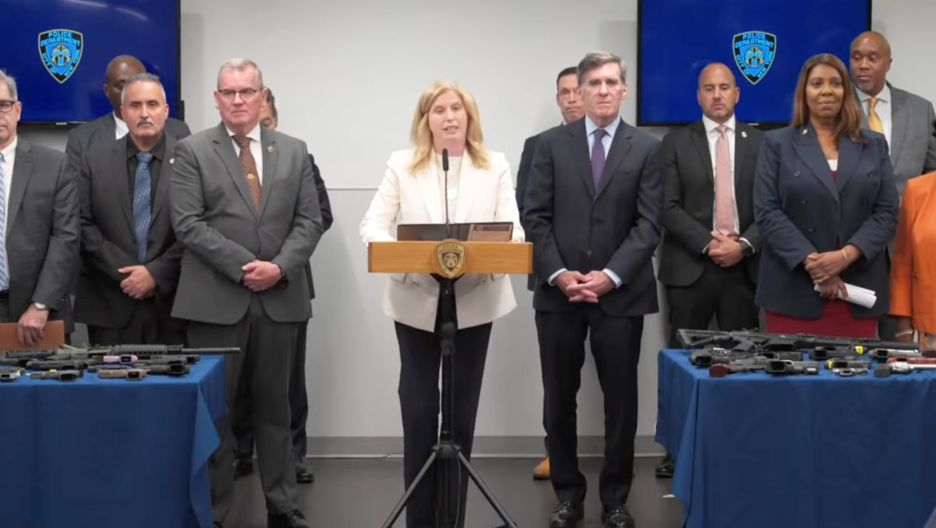
Parker (R of center, in purple tie) stands alongside NYPD Commissioner Tisch on August 11, 2026, as she announces the removal of more than 3,000 guns from New York City streets in 2026. Source: NYPD. The GVSP started with a North Star, which I think is the basic bedrock principle of how you build a partnership. Our North Star is to reduce the number of people who are shot in New York City. We count the days in a row when nobody is shot. At the center of our table is a statue of Sisyphus pushing his boulder up the side of a mountain. As we describe it, the boulder at the top of our mountain is a day when nobody is getting shot in New York City. Some days we have bad days, as you have in any city. But at one point this year, nobody was shot in New York City for five days in a row. Gun violence is lower than it’s been in recorded history for New York City, and the GVSP is part of the reason. There are so many things that the NYPD and their partners do across the city, with task forces, precision policing, and all sorts of initiatives. But part of the reason is to be laser-focused on the small number of people who are involved in the most gun violence, and getting them off the street when they are arrested for a new gun violence felony—shooting somebody, robbing somebody with a gun, illegal possession of a gun. That is what we are celebrating and recognizing this week. Wexler: How do you manage the egos and varied interests involved when 35 different agencies come together? Parker: One of the people we’ve studied as a model of leadership for what we’re trying to accomplish is General Stanley McChrystal, particularly what he wrote in his book Team of Teams. Whether it’s law enforcement, public health, the military, or a company, organizations depend on other organizations to do their job well. So in law enforcement, if our goal is for nobody to get shot in New York City, that depends on building a team of teams. You have the police officers who do the brave and hard work on the front lines. They make the arrest. They have to coordinate with the prosecutor. The defendant may have another case open in another county. The person may be on probation or parole. They may have been involved in domestic violence. All these different component parts matter. And if you put them all together, the district attorney is able to build the strongest case possible for that judge to make the most informed decision. I think the way it holds together—and General McChrystal talks about this as well—is the shared purpose, or North Star. Everybody at that table agrees that their North Star is for people in New York City to be safe. We have to be laser-focused, and we’re only focusing on people. We discuss about three people a day. They’re people who were arrested for a gun violence felony in the last 24 hours and have something else—are on parole, on probation, out on an open gun violence felony, or have previously been convicted of a gun violence felony. Detectives begin reviewing cases at 3:00 in the morning. At 7:00, all our different partners are given the names of the people we’re going to be talking about. At 10:00, we start our meeting, both in person and on Zoom. We review these cases and share information. We then do what we call a one-day look-back. We look back and say, “What happened yesterday? What bail was requested? What bail was set? What was the name of the judge?” Then we say, “What happened two weeks ago?”—in other words, “Was this person indicted?” And then, “What happened two years ago? What ever happened on that case?” In that process, we’re always looking for any gap or anything we could have done better. But it’s very respectful. It’s very constructive. We all know the strength of this partnership is all of us working together side by side. And we keep getting better and better because we share this information. We just keep pushing that boulder up the hill together. Wexler: What advice would you give an agency that wants to replicate this but doesn’t have New York City’s resources? Parker: In our case, we have some resources from HIDTA for support analysts and that sort of thing, but basically people are using their own existing resources to do it. I think this initiative is replicable anywhere in the country at any level, if you have a small number of people who are responsible for your gun violence and depend on other agencies to tackle that problem. We started with just a few people around a table and then it grew to 35 agencies. I think the key ingredients are your police chief and district attorney, because every day they’re focused on it. From there you ask probation and parole. And our meeting is 20 or 30 minutes. It’s not a lifelong commitment. It’s really focused and effective. So I think it’s replicable in any city in America, and I think it’s replicable for any challenge we face in America.
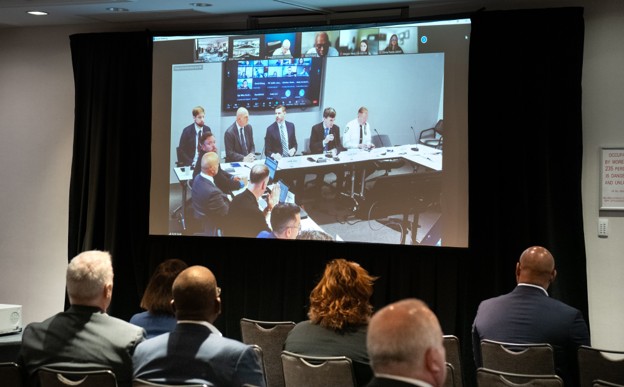
Attendees at PERF's 2023 Annual Meeting virtually participate in a GVSP meeting led by Parker. Wexler: You used a similar approach for RxStat, which was New York City’s strategy to reduce opioid overdoses. Tell me about that program. Parker: It was a Mayor Michael Bloomberg–led initiative, and I was a part of it. He is a great leader and, among other things, very focused on data. He pulled together all these federal, state, and local partners from public safety and public health to imagine a drug strategy for New York City. And that was a data-driven strategy called RxStat. It set a North Star of reducing the number of people who die of a drug overdose. That was a shared North Star for 15 or 20 different agencies across many disciplines. And the HIDTA program was able to support that because we have resources and reach. The idea was that we need to get data for drug overdoses like we get for shootings and other serious crimes in policing. You need to get timely, accurate intelligence to make effective strategic decisions. And when you get the data, you start to think, “What are the gaps—the things we could do to save lives?” I remember being at one of your PERF meetings in Washington years ago, at about this same time. The question you posed was, “Should law enforcement be carrying naloxone, which is a life-saving tool?” And there was some debate about whether they should or they shouldn’t. But I think from that, the consensus in law enforcement became that we should be carrying naloxone. We’re in the life-saving business. We’re not in the moral judgment business. If somebody is dying of an overdose at our feet, we want to have every tool. And police officers have gotten down on their hands and knees and saved thousands and thousands of lives [with naloxone]. Because that’s what they do; they protect us and will do everything they can to save lives.
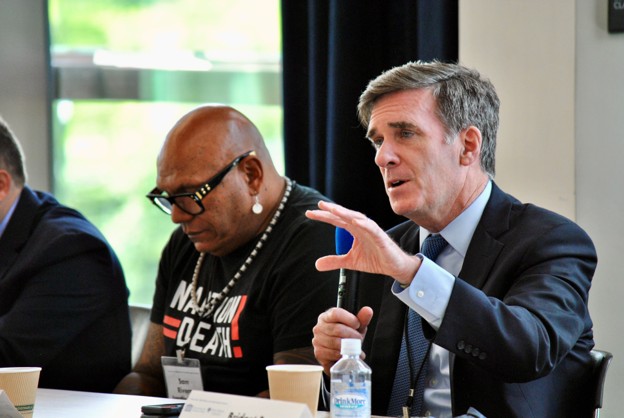
Parker speaks at PERF’s 2024 meeting on combating the opioids crisis. Wexler: Officials from public health and law enforcement don’t always get along well. How do you work with partners who don’t always see eye to eye? Parker: I found that the key principle for building partnerships is not to find the ways we disagree, but to find common ground or our common North Star. General McChrystal talks about this as a shared common purpose. Where is it that people do agree? Well, where public health and public safety passionately agree is that they want to do everything they can to save lives. They may have different strategies about how to get there. They may have different roles and responsibilities. But they’re passionate about it. So you say, “How can we reduce the number of people who die of a drug overdose and be agnostic about how we do it?” If naloxone is one of the ways to reduce overdoses and save lives, then police officers and other first responders need to carry naloxone. There are challenges, but I’ve found that it actually comes together when we’re really clear about what our North Star is. People will come together, roll up their sleeves, and work together. RxStat has 20 different agencies—city health, state health, drug treatment, the medical examiner, federal drug enforcement, local drug enforcement, and prosecutors. It’s held together for over 15 years. It’s now what we call the overdose response strategy and, thanks to the leadership of ONDCP [the Office of National Drug Control Policy] and the HIDTA program nationwide, it’s now a model across the country as a partnership between HIDTA and CDC. Together, public health and public safety are building partnerships in every single state to reduce overdose deaths. Wexler: As someone who has spent his career working closely with police but is not a police officer himself, what insights do you have into the profession? Parker: To start with, the police are my heroes. I saw on 9/11 and see as a prosecutor that police will risk their lives to protect people they don’t know, without hesitation. That’s the DNA. They’re imperfect. Prosecutors are imperfect. But I start with a passionate admiration for what it means to be a police officer. And I mean that broadly—a police officer, federal agent, or anybody who’s on the front lines. I think the key thing that’s missing sometimes is that agencies can’t do it all on their own, and there are partners they need to be able to do their jobs even better. If you’re a police officer, you need a platform that gives you other tools in your tool chest to keep people safe. That’s why I love this GVSP. Too often, 9-1-1 is the only number people know for any problem they have, whether a dog is barking too loudly, a car is double-parked, people are smoking marijuana, there’s a homeless person somewhere, or someone is having mental health issues. Too often, all of that is poured on the shoulders of police officers. I think they welcome the idea of bringing other people to that struggle, but we need these partnerships in place to do so. I greatly appreciate Chauncey taking the time to share his thoughts with our members! He is, as the late NYPD, Philadelphia, and Miami police leader John Timoney said about people he admired, “a bird of rare plumage.” Chauncey sees the big picture and has a way of breaking down complicated issues and getting people who don't always get along to work together. I think he’s the Will Rogers of policing—meaning he’s never met someone he doesn’t like. He is one of the hardest-working and most effective leaders of our time, and I thank him for his many contributions to the field. Best, Chuck |