|
January 10, 2026 A compelling week for policing
PERF members, Today I’ll touch on a few topics recently in the news. ICE shooting in Minneapolis It is hard to watch the images coming out of Minneapolis and not feel a profound sense of empathy for that city—its residents and its cops. After all that Minneapolis has gone through, it feels eerily surreal to see a community being torn apart once again. Minneapolis is a different city, and the Minneapolis Police Department is a different police department, than they were in 2020. Minneapolis is different today because of the hard work invested in building trust between the police department and the community. And, as we go to print, Portland, Oregon—another city that in 2020 endured a hundred days of demonstrations but has emerged stronger nonetheless—is responding to a shooting by federal agents and preparing for possible community unrest. Both Minneapolis and Portland are fortunate to have experienced and skilled police chiefs in Brian O’Hara and Bob Day to help them navigate these turbulent times. As the federal government continues to increase the role of ICE and other federal agencies in enforcing federal immigration laws in U.S. cities, those agencies would be well served to reexamine and reinforce both their policies and their training, in particular, with respect to traffic stops. Many of the most controversial shootings by ICE agents have involved traffic stops. Wednesday’s shooting in Minneapolis was the ninth instance in the past four months in which ICE officers fired on people in vehicles. Local police officers make tens of thousands of traffic stops every day. Even if it’s only to issue a warning or a ticket, officers understand the tensions and potential dangers inherent in traffic stops, and they receive extensive training in how to conduct them safely. Many federal agents may be unaccustomed to making traffic stops in urban areas and may have less training and experience than their local counterparts in these types of encounters. Add to that the fact that the targets of traffic stops by federal agents might be facing possible detention and deportation, and the dynamic becomes all the more volatile. A traffic stop may be a life-changing event for people facing deportation, and drivers and occupants may do everything they can to elude police. Given this risk, federal agents deserve the latest training and policies. For their own safety, local police are trained not to position themselves in front of a vehicle and to move out of the way if a vehicle is approaching. Many agencies have followed the guiding principles issued by PERF in 2016 and updated their policies to expressly prohibit firing into a moving vehicle unless the occupants are firing at officers or are engaged in a mass ramming incident. Agencies understand that shooting at a driver has the potential to turn the vehicle into an uncontrollable missile that can endanger the officer and other people as it barrels down the street. That is just what happened in Minneapolis. Fifth anniversary of the January 6 attack on the U.S. Capitol Tuesday marked five years since the January 6, 2021, attack on the U.S. Capitol by a mob attempting to prevent lawmakers from certifying the results of the 2020 presidential election. Hundreds of police officers responded to the Capitol that day to protect not just a building but democracy itself. Scores of those officers suffered both physical injuries and psychological trauma that they live with to this day.
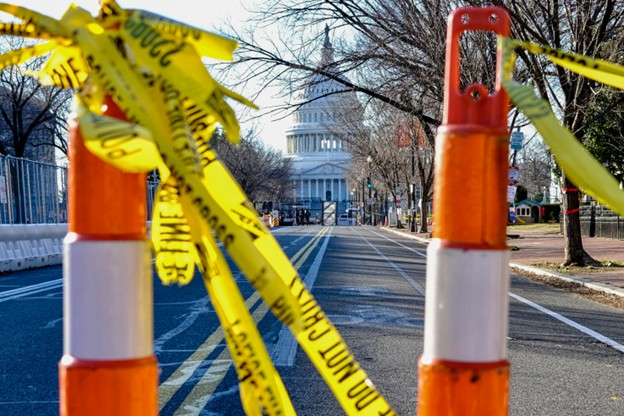
The U.S. Capitol under lockdown following the events of Jan. 6, 2021. That trauma was compounded when President Trump, on his first day in office, pardoned or commuted the sentences of nearly 1,600 people charged for crimes they committed that day, including assaulting police officers. At the time I wrote that “every single individual who attacked police officers, broke into the Capitol, and hunted for politicians to harm was pardoned or had their sentence commuted. . . . That’s not justice for those officers, or for our democracy.” Now, some of our nation’s leaders are still seeking to rewrite the history of that tragic day. On Tuesday, the White House published a new web page marking the anniversary. It minimizes and obscures the events of that day and grossly distorts the brave and heroic actions of the police officers who defended the Capitol. For example, the White House website actually blames the Capitol Police for escalating tensions that day. Its timeline of events states that from 1:10–3:00 p.m., “Capitol Police aggressively fire tear gas, flash bangs, and rubber munitions into crowds of peaceful protesters, injuring many and deliberately escalating tensions. . . . These inconsistent and provocative tactics turned a peaceful demonstration into chaos.” We all know there is a time and place for de-escalation, but being physically attacked by a massive and angry mob is not one of them. Police officers that day were overwhelmed by protesters armed with flagpoles, baseball bats, fire extinguishers, even shields and pepper spray taken from officers. Far from escalating tensions, I think the officers that day showed remarkable restraint and professionalism in the face of grave danger to themselves and others, including members of Congress. The White House website also states that “zero law enforcement officers lost their lives.” That statement is a slap in the face to the family, friends, and colleagues of U.S. Capitol Police Officer Brian Sicknick, who was assaulted by some of those pardoned and died the next day after suffering two strokes. And to U.S. Capitol Police Officer Howard Liebengood and Metropolitan Police Officers Jeffrey Smith, Kyle DeFreytag, and Gunther Hashida—all responded to the riot and died by suicide in the subsequent days and months. The website also ignores the fact that at least 140 officers—probably many more—were injured that day, some of them suffering career-ending injuries. Or that many of the officers from January 6 still carry psychological scars, including PTSD; some have decided to leave policing altogether. The police officers who served on January 6 deserve our thanks and recognition. In March 2022, Congress passed a law requiring that within one year, a plaque be placed in a prominent location in the Capitol to honor the men and women who protected lawmakers and defended democracy—much like the plaque that honors Capitol Police Officer Jacob Chestnut and Detective John Gibson, who were murdered in 1998 defending the Capitol. Yet Congress has been dragging its feet on implementing the law. Only this week did the Senate pass a resolution authorizing the installation of the plaque at a temporary location in the Senate wing of the Capitol. I sincerely hope our country can one day move past the events of five years ago. But that can’t happen until we’re honest about who attacked our democracy and who protected it on January 6, 2021. Study of officer mortality Last Friday’s PERF Daily Clips included an article about a recent study of mortality among U.S. law enforcement officers. The study, conducted by Peter T. Tanksley, J.C. Barnes, J. Pete Blair, and M. Hunter Martaindale and published in The Lancet Regional Health, used National Occupational Mortality Surveillance data from 2020–2023 to compare officers to the general population. The research team found that both male and female law enforcement officers had higher crude mortality rates and age-standardized mortality rates than their counterparts in the general population. Male officers had higher mortality rates than female officers, but there was a greater gap between the mortality rates of female officers and the overall female population than male officers and the overall male population. The leading causes of death among male officers were circulatory conditions; external causes, such as suicide, motor vehicle crashes, accidents, and homicide; and cancer. Male officers died of circulatory conditions, cancer, and suicide at a greater rate than the general population, and of other external causes at a lower rate than the general population. Among female officers, the leading causes of death were cancer, circulatory conditions, and external causes, each occurring at a higher rates than in the general population. In conclusion, the study’s authors write that law enforcement officers “face a unique constellation of occupational hazards that contribute to increased mortality risk. Our findings underscore the need for targeted intervention and prevention efforts to reduce the burden of cardiovascular, cancer-related, and suicide mortality among [law enforcement officers].” In recent years, PERF has published reports on law enforcement-specific residential treatment centers, strategies for strengthening wellness programs, and suicide prevention in the policing profession. We will continue that focus on officer wellness with a new project that looks at mortality risks more generally. I hope we can shed light on some important questions, such as these:
Look for more information about this project in the coming weeks and months. Former Jets wide receiver Laveranues Coles’s second career Finally, I recommend everyone read a piece published last month in The Athletic about Jacksonville, Florida, police officer Laveranues Coles, whose name many of you may recognize from his 11-year NFL career. Coles traveled a difficult path to get to the NFL. He grew up in poverty, and his stepfather sexually abused him for three years. The police responded after Coles beat up a friend at age 13, and an officer convinced him to reveal his underlying trauma. When Coles told the cops what his stepfather had done, they brought him in and charged him; he pleaded guilty and went to prison on a nine-year sentence. Then, while attending Florida State University, Coles broke up a fight between his mother and stepmother, and police charged both him and his stepmother with misdemeanor battery. And later, he and a teammate accepted an unauthorized discount from a department store clerk and served 10 days in a work program for petty theft. Despite his legal trouble, the New York Jets drafted him in the third round of the 2000 NFL draft, and Coles flourished in the NFL. After retiring, Coles took up a few hobbies, pursued some business endeavors, and settled into family life. But a childhood friend who became a Jacksonville police officer believed Coles would be good at police work and encouraged him to join the profession. Last year Coles graduated from the academy. These are unusual circumstances, but I think there’s a lesson here about looking for officers who have followed unconventional paths. Those who get into some trouble in their youth can become excellent police officers. Coles’s early experiences and the lessons he learned will make him an insightful mentor to kids from disadvantaged backgrounds. As former Jets quarterback Chad Pennington told The Athletic, “Our youth needs leaders like him who have similar stories and can relate but also provide them a source of truth to say, ‘Look at my story—this doesn’t have to be this way.’” Have a wonderful weekend! Best, Chuck |